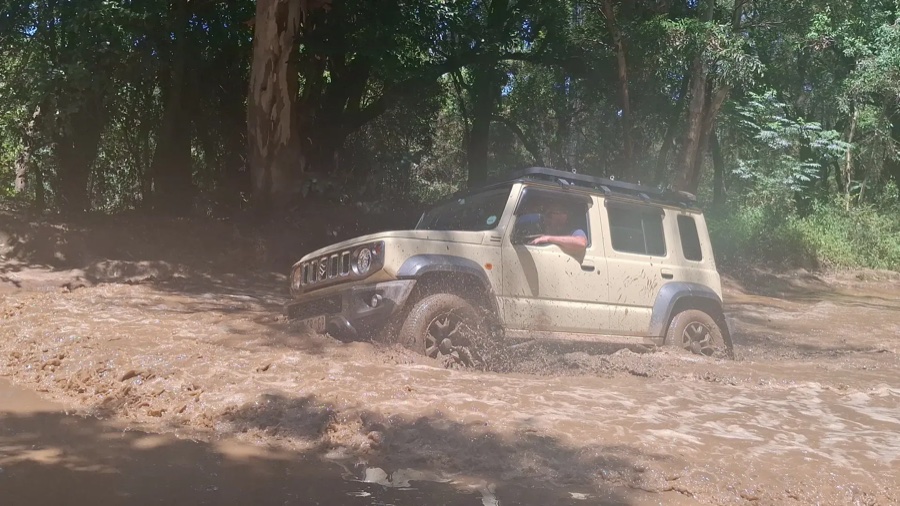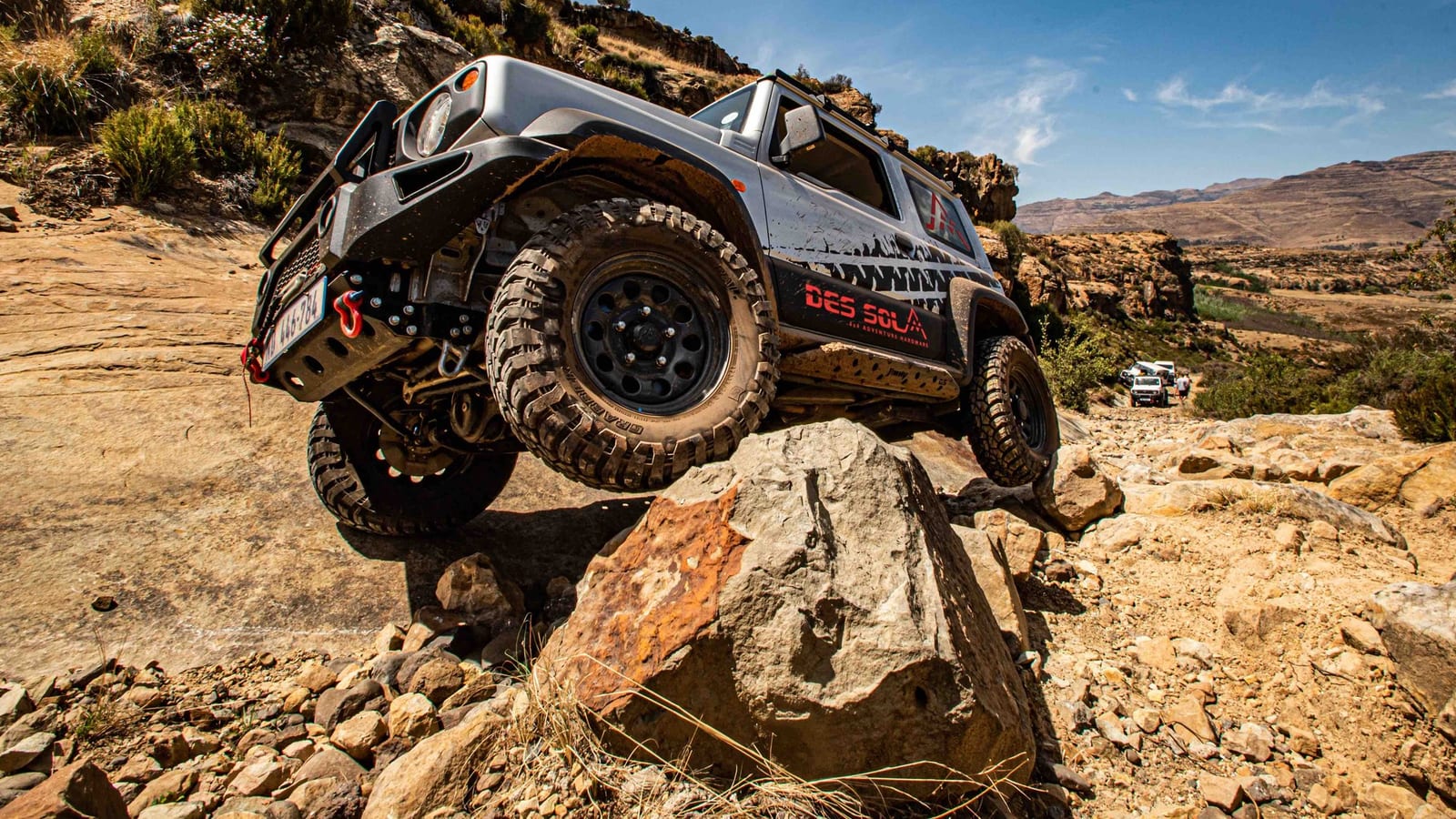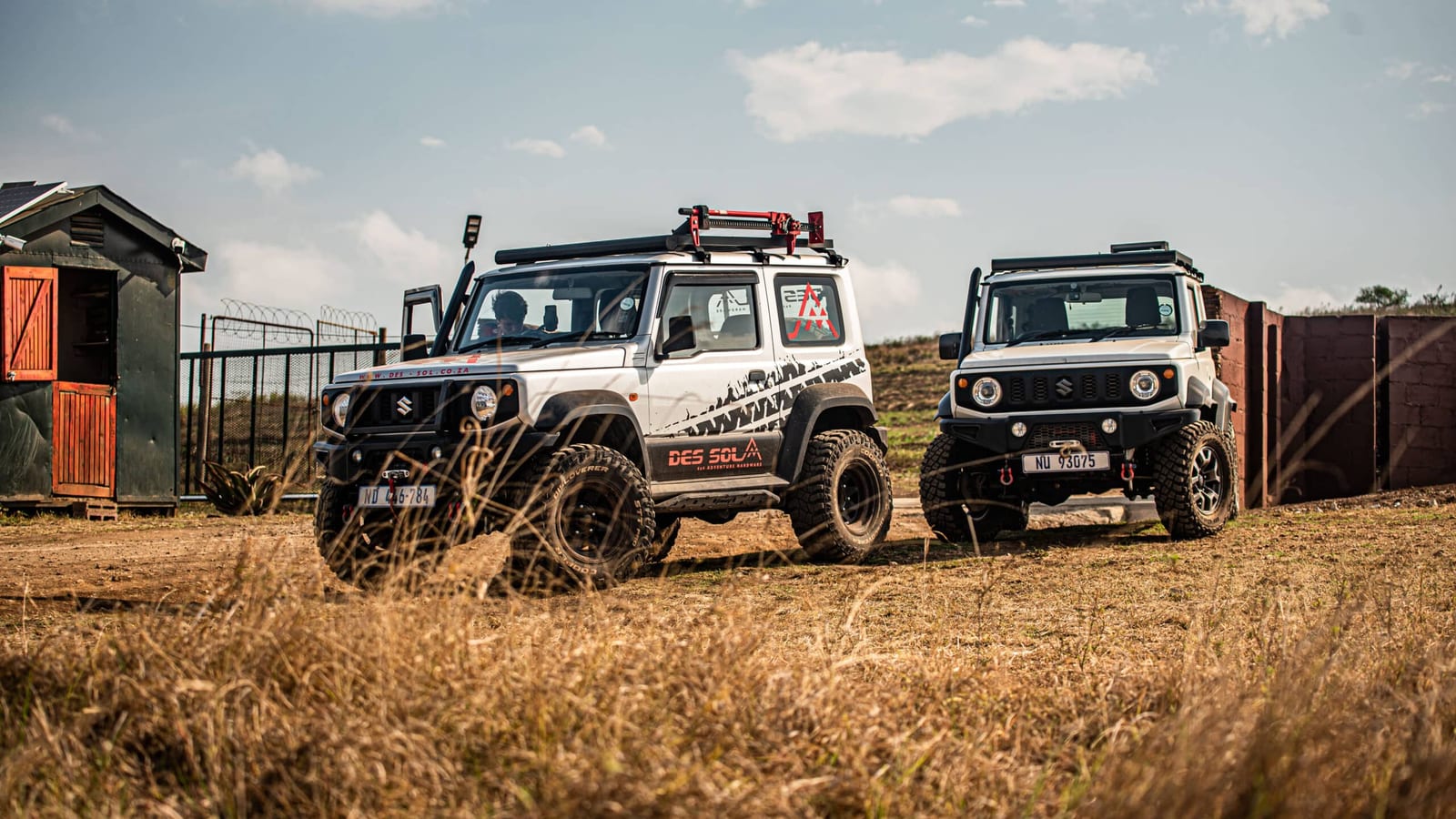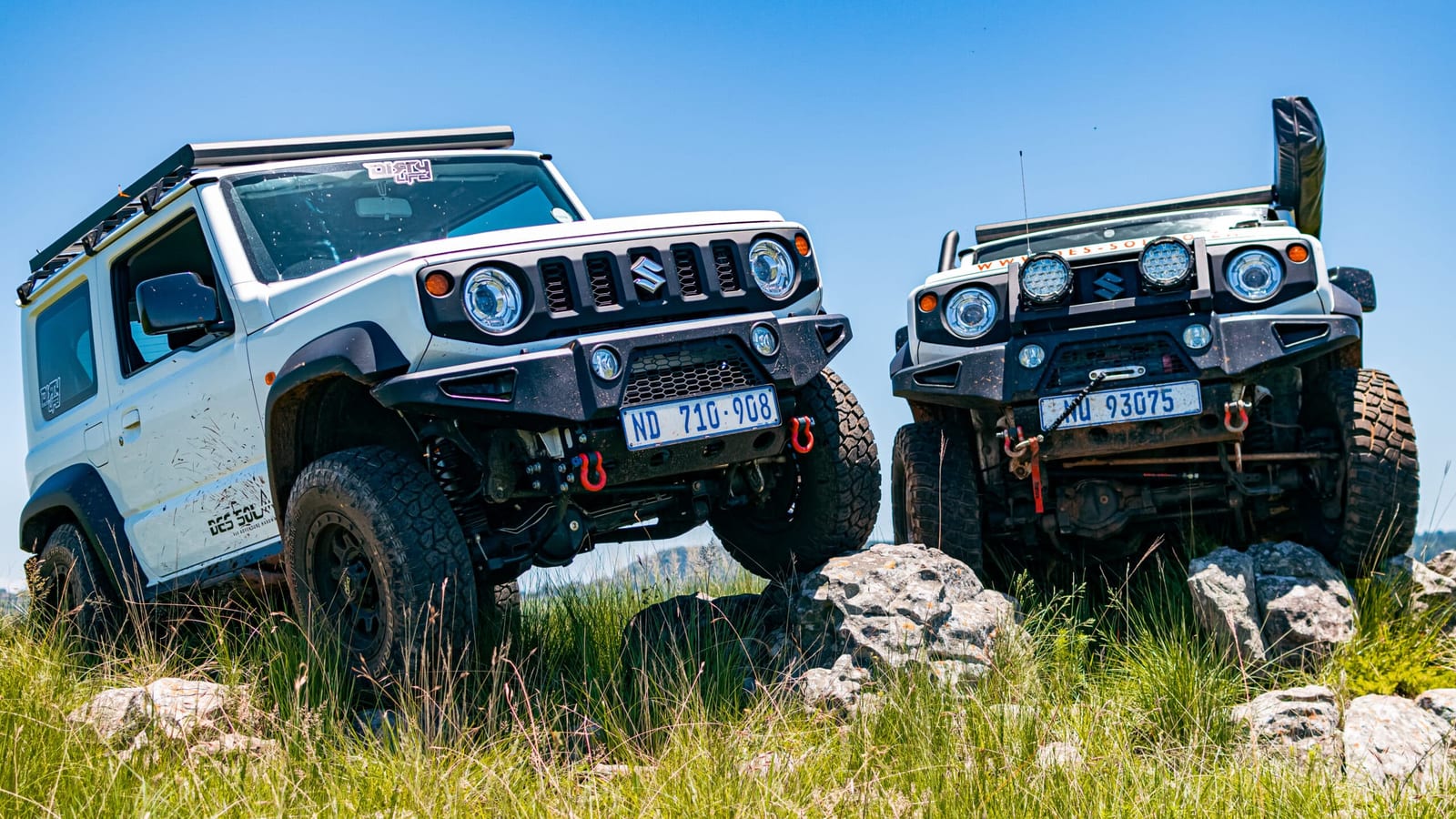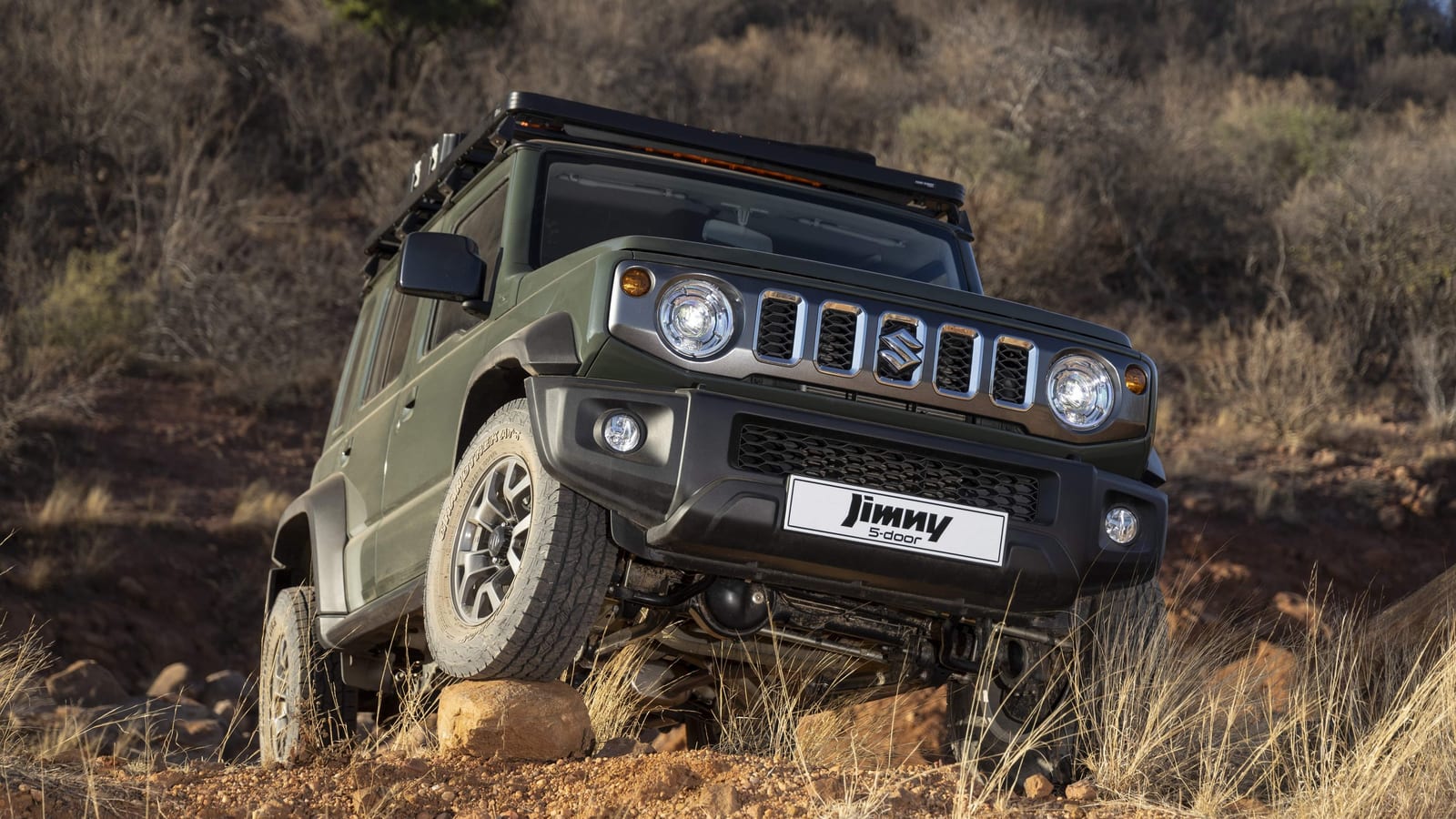
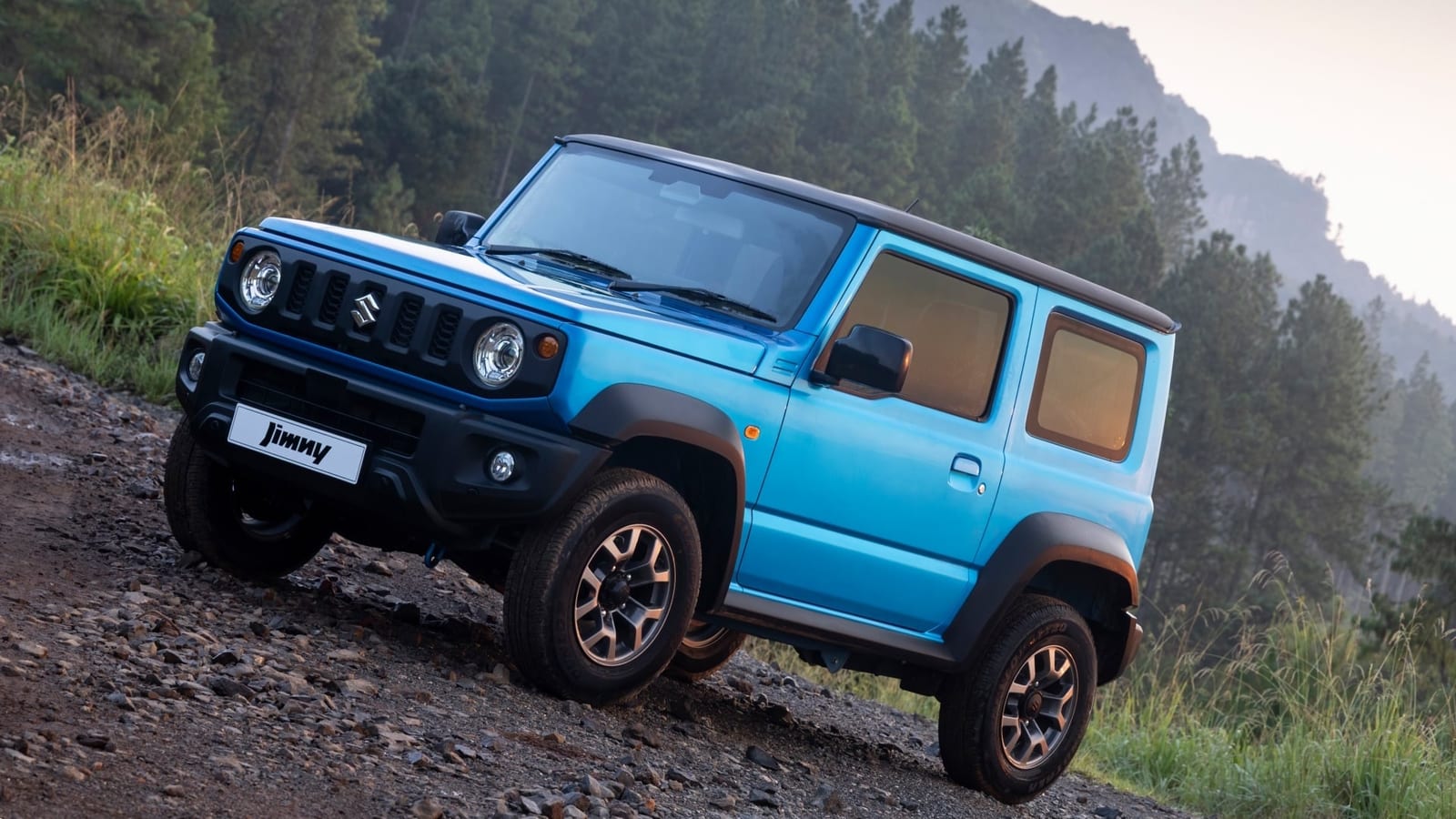
Cover photo: Suzuki Auto South Africa. A bone-standard 3-door, factory tyres and all, pointing up a slope most SUVs would not try.
Yes, the Suzuki Jimny is a real 4x4. Ask on a South African 4x4 forum and you get a three-part test: does it have low range, two solid axles and a ladder frame? The Jimny has all three. Most small SUVs have none of them.
Whether it is the right 4x4 for you is a different question. It is small, light and slow. It carries little and tows little. It hates a crosswind on the N1. But on a slow, steep, rocky track it goes places that surprise people in far bigger 4x4s.
This guide covers what the 4x4 hardware does, the numbers, where it beats bigger 4x4s, where it loses, and which SA trails prove it.
The short answer
- Is it a real 4x4? Yes: low range, a solid axle front and rear, and a ladder frame.
- Are all Jimnys 4x4? Every new Jimny sold in South Africa is. There is no two-wheel-drive version.
- Is it good off-road? On slow, technical ground, very. SA magazine testers and owners agree.
- Where does it lose? Power, fuel range, load, towing and long highway days.
- Who should buy one? Someone who wants a proper 4x4 for weekends, passes and training days, for two people and light gear.
Is the Jimny a real 4x4?
Many “4x4” SUVs are really crossovers. They drive all four wheels, but they are built like a car. They have no low range, no separate frame and no solid axles. They cope with wet tar, gravel and a bit of sand. They struggle on steep, rocky ground at walking pace.
The Jimny is built the old way. Suzuki Auto South Africa lists each part of the test on its own pages:
| The test | What the Jimny has | What it means in plain words |
|---|---|---|
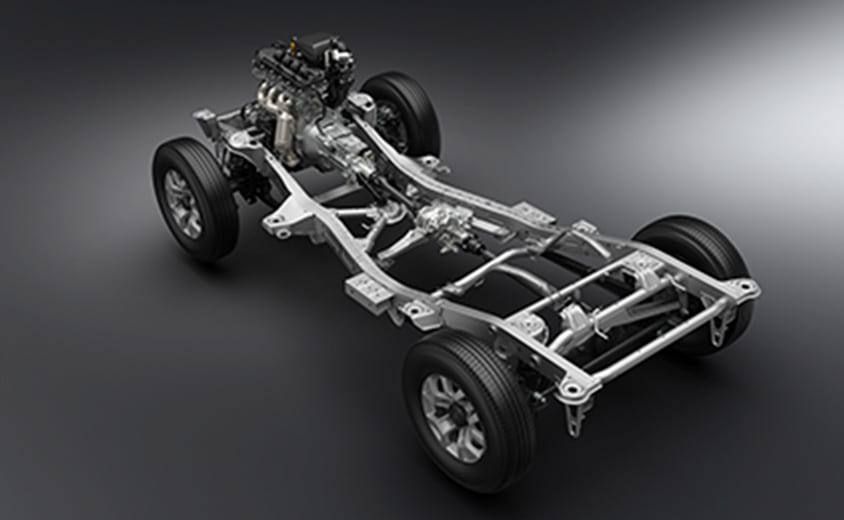
| Ladder frame | A “rigid ladder frame chassis” | A strong steel frame under the car, like a bakkie. The body bolts on top. |
| Solid axles | A rigid axle on coil springs, front and rear | One solid beam joins the two wheels at each end. |
| Low range | 4x4 with a “low-range transfer gear” | A set of extra-low gears for crawling up and down steep ground. |
A Suzuki dealer who posts on 4x4community put the local view well. When a Duster owner argued, the dealer’s whole reply was to ask whether the Duster had low range, two solid axles and a ladder frame. It does not. That is the gap.
Suzuki calls the Jimny’s 4x4 system AllGrip Pro. Owners seldom use the name. They just say “low range” and “the lever”.
Are all Jimnys 4x4?
Every new Jimny Suzuki sells in South Africa is a 4x4 with low range. That covers the 3-door and the 5-door, manual and auto, GL and GLX. Neither of Suzuki SA’s model pages lists a two-wheel-drive version.
Buying used? We analyse thousands of Jimny adverts, old and new. We have not seen a two-wheel-drive Jimny among them.
One tip for the older Jimny (1998 to 2018). Its 4x4 works with push buttons, not a lever. If the 4x4 is never used, the part that engages it can rust and stick. One Karoo owner shifts into 4H and 4L now and then, sommer while he waits at a robot. Our common problems guide has more on buying an older one.
Does the Jimny have a ladder frame?
Yes. The frame is a strong steel ladder under the car, and the body sits on top of it. Bakkies are built this way.
Suzuki says the Jimny has used a ladder frame since the very first one in 1970. A frame like this copes well with the knocks and twisting of rough ground. It is also why the Jimny feels solid on a rocky trail and a bit busy on tar.
What the 4x4 hardware does
Here is each part in plain words, as Suzuki explains it.
| Part | What it does |
|---|---|
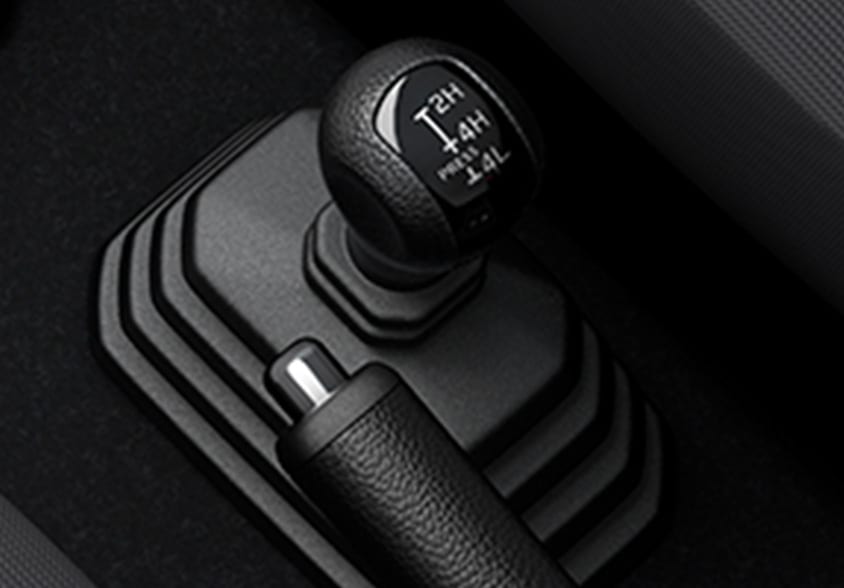
| The 4x4 lever | A second short lever next to the gear lever. It picks 2H, 4H or 4L. It is mechanical, not a button. |
| 2H | Two-wheel drive. Suzuki says to use it on tar. |
| 4H | Four-wheel drive in normal gears, for dirt and gravel. |
| 4L (low range) | Four-wheel drive in extra-low gears, for steep, rocky or soft ground at walking pace. |
| Solid axles | When a rock pushes one wheel up, the axle pushes the other wheel down. That keeps more tyre on the ground. |
| Traction control | If wheels spin, it brakes them, so the drive goes to the wheels that still grip. |
| Hill descent control | Holds a slow, steady speed down a steep hill without you touching the brake. |
| Hill hold | Stops the car rolling back for about two seconds when you pull away on a steep slope. |
A few things to know about how these work in real life.
Use 2H on tar. The Jimny’s 4x4 has no centre diff, the part that lets the front and back wheels turn at different speeds. With 4H on dry tar, the car fights itself in corners. So 4H is for loose surfaces only.
Low range is slow on purpose. SA 4x4 magazine found first gear in low range very short, so the car crawls. Its testers liked second gear in low range for sand.
Hill descent works in both 4H and 4L. Suzuki’s 5-door brochure says it holds about 10 km/h in 4H. In 4L it holds about 5 km/h.
It has no diff lock. A diff lock locks the two wheels on an axle together, so both turn even if one is in the air. The Jimny has none, front or rear, from the factory. Its traction control does a similar job by braking the wheel that spins. SA 4x4 called it “rudimentary, yet effective” on steep climbs with wheels in the air. The same testers said it is not as good as a proper locker.
The numbers that matter off-road
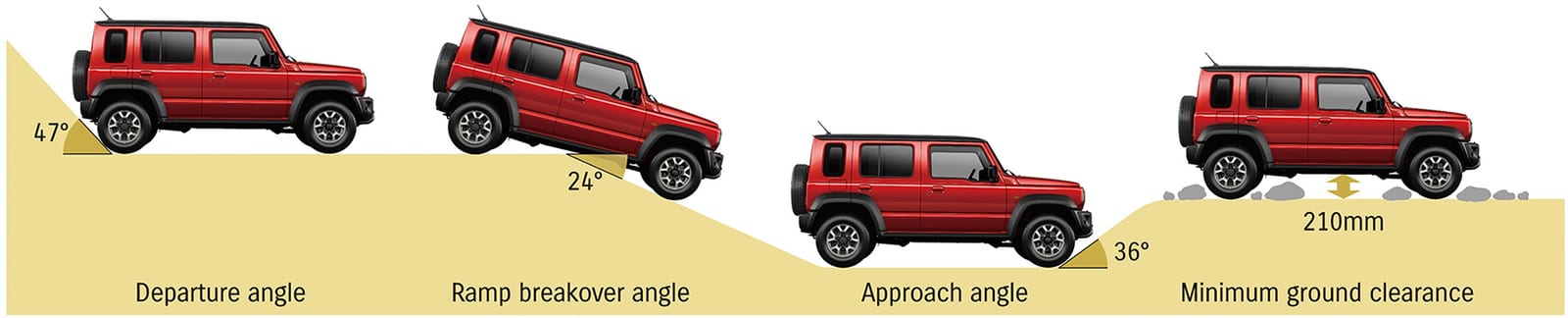
These are Suzuki Auto South Africa’s own figures. Many overseas reviews quote different angles from other markets, so use these ones.
| 3-door | 5-door | |
|---|---|---|
| Ground clearance | 210 mm | 210 mm |
| Approach angle (the nose) | 36 degrees | 36 degrees |
| Breakover angle (the middle) | 27 degrees | 24 degrees |
| Departure angle (the tail) | 47 degrees | 47 degrees |
| Wheelbase | 2,250 mm | 2,590 mm |
| Turning radius | 4.9 m | 5.7 m |
| Kerb weight | 1,095 to 1,110 kg | 1,185 to 1,215 kg |
| Engine | 1.5 petrol, 75 kW, 130 Nm | same |
| Gearboxes | 5-speed manual, 4-speed auto | same |
| Fuel tank | 40 litres | 40 litres |
In plain words, the angles tell you how steep a bank the car can drive onto or off before the bumper hits. The Jimny’s are steep. Its nose and tail barely stick out past the wheels.
The breakover angle is about crests. A long car can get stuck on its belly at the top of a sharp hump. The shorter 3-door is better at this.
Both bodies have the same 210 mm of ground clearance. The 5-door is not lower. It is just longer, so it turns wider and is a little worse on crests.
Where it beats bigger 4x4s
South Africans don’t measure the Jimny against a Jeep Wrangler. They measure it against the Fortuner, the double cab and the Land Cruiser on the same trail. So here it is next to two of them, using each maker’s own SA figures.
| Jimny 3-door | Jimny 5-door | Toyota Fortuner 4x4 | Land Cruiser 79 double cab | |
|---|---|---|---|---|
| New price from | R444,900 | R439,900 | R754,000 | R959,300 |
| Approach angle | 36 degrees | 36 degrees | Not published | 33 degrees |
| Departure angle | 47 degrees | 47 degrees | Not published | 27 degrees |
| Ground clearance | 210 mm | 210 mm | 279 mm | 235 mm |
| Length | 3,485 mm | 3,820 mm | 4,795 mm | 5,235 mm |
| Turning radius (maker’s figure) | 4.9 m | 5.7 m | 5.8 m | 7.2 m |
| Kerb weight | 1,095 to 1,110 kg | 1,185 to 1,215 kg | Not published | 2,165 to 2,490 kg |
| Fuel tank | 40 litres | 40 litres | 80 litres | 130 litres |
Prices and figures from Suzuki Auto South Africa and Toyota South Africa, seen on 23 September 2026.
Four things stand out.
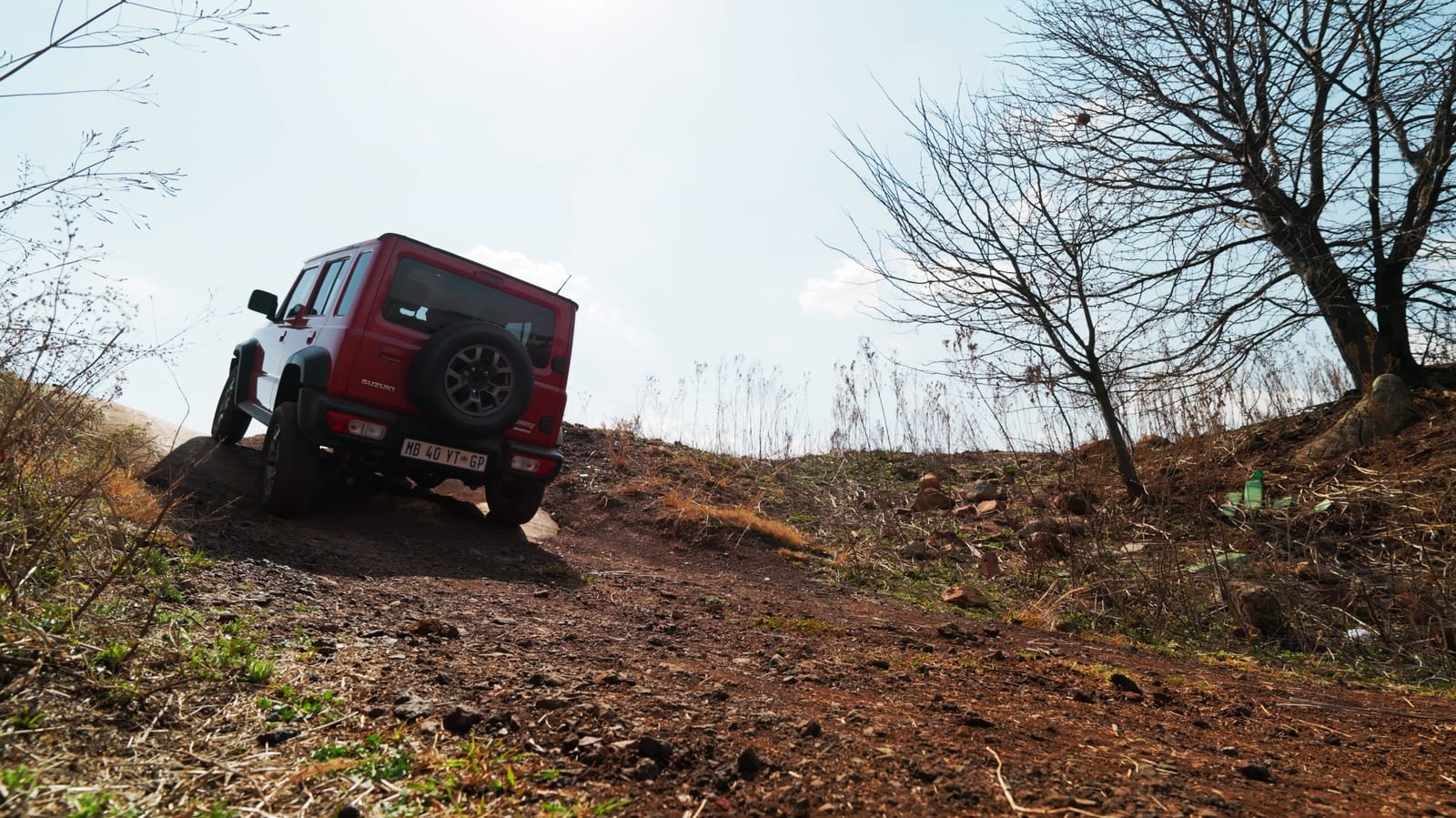
It is small. The 3-door is about 1.3 m shorter than a Fortuner. It is about 21 cm narrower too. On a narrow bush track, that is the difference between squeezing past a tree and reversing to try again.
It turns tight. A 3-door turns in a much smaller space than a Land Cruiser 79. On a switchback or a tight rocky corner, the Jimny just goes. The big car shunts.
Its nose and tail sit high. The departure angle is 20 degrees steeper than the Land Cruiser 79’s. The tail is far less likely to catch a ledge or the bank of a donga.
It is light. A 3-door weighs about half as much as a Land Cruiser 79 double cab. In sand, weight is the enemy. SA 4x4 found the Jimny glides over sand where a heavy car digs in. It is also easier to pull out when it does get stuck.
And the price: the cheapest new Jimny costs about R314,000 less than the cheapest new Fortuner 4x4. SA 4x4 put it simply in its 2019 test: for the money, nothing else comes close.
What SA testers and owners found
Three South African magazine tests took a standard Jimny off-road.
| Test | Where | What they found |
|---|---|---|
| SA 4x4, February 2019 | Their off-road test route | Angles “almost preposterous”. Traction control effective on steep climbs with wheels in the air. |
| SA 4x4, June 2021 | Ou Trekpad, Western Cape | The 4x4 lever engages almost instantly. The light car glides over sand. |
| CAR, May 2026 | Honingklip 4x4 course, near Bot River | ”The Suzuki excels off-road.” It cleared most obstacles without touching them with its body. |
Owners tell the same story, in their own words, on 4x4community.
- Mapungubwe. A brand-new, completely standard Jimny ran with a Defender 130. On dirt, thick sand and rock it did as well as the Defender. Its only weak point was fuel. The nearest pump was 70 km away, so the Defender carried the jerry cans.
- The Namib. A 3-door owner did a five-day guided desert trip with water, fuel and a fridge on board. It never got stuck in the dunes. His advice: the only mod you really need is good all-terrain tyres.
- Sani Pass. A standard Jimny on factory tyres went up in snow and in the dry. Owners say keep your momentum and you barely need low range in the dry.
- The Kalahari. One owner’s son drove a new Jimny in the dunes every day for a year on a research project. His father says it is still extremely capable.
- Baboon’s Pass. A Jimny with a lift and bigger tyres did the pass with no damage. Its owner called it the most impressive car on that trip.
You will not be the only Jimny out there, either. CAR counted 1,127 Jimnys at the 2025 Jimny Gathering in the Outeniqua mountains. Other favourites include the Baviaanskloof, the Swartberg Pass and Prince Alfred’s Pass.
Where it loses to bigger 4x4s
Owners who love the Jimny are honest about this list.
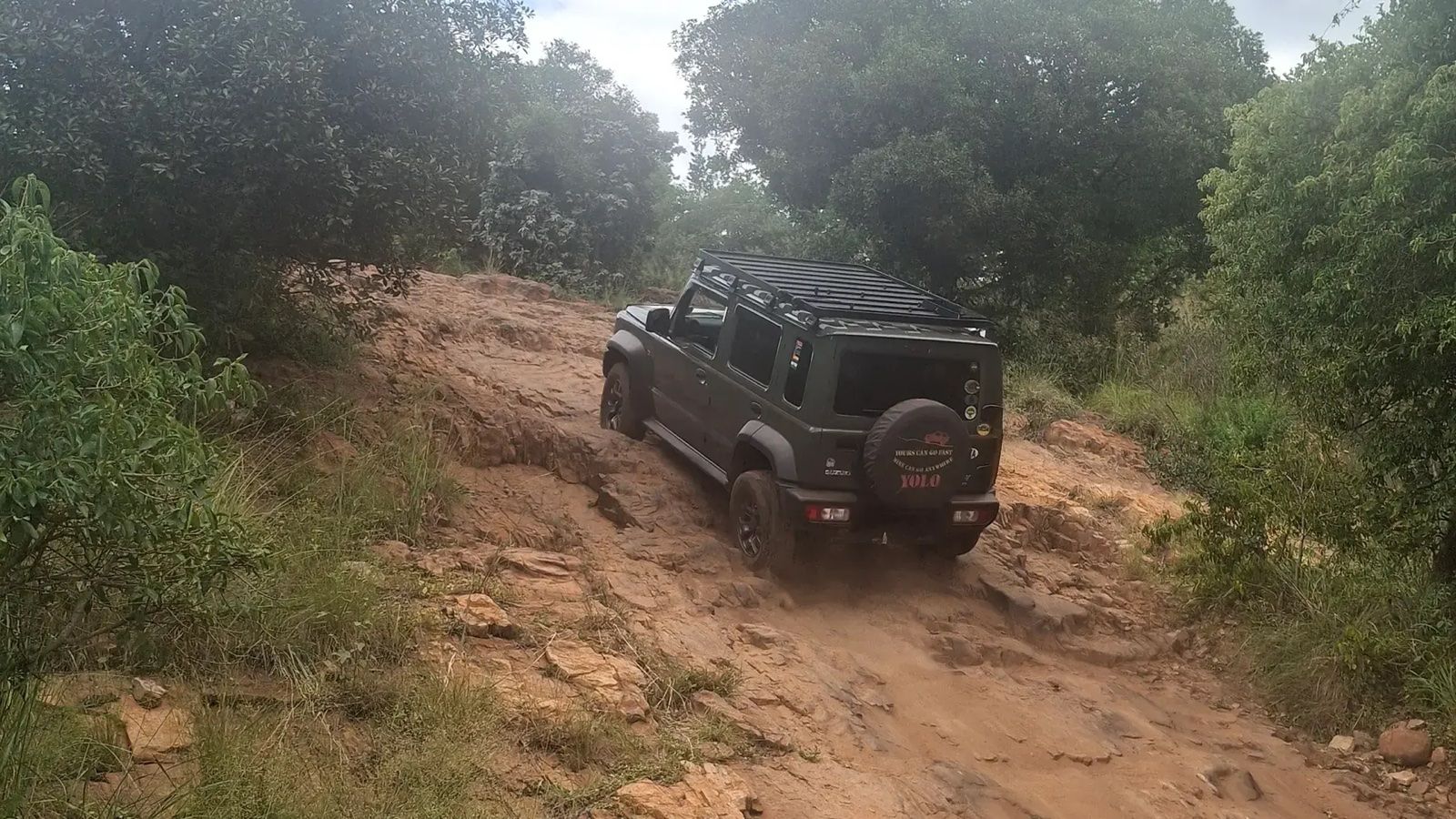
Power. The 1.5 petrol makes 75 kW and 130 Nm. In low range on a rocky climb, that is enough. On long, soft sand climbs, owners say it runs short. South Africans are used to 2.8 turbo diesels, and the Jimny petrol needs revs.
The traction control in sand. Some owners find it cuts power on long, steep sand climbs, just when they need momentum. Check your owner’s manual for how to switch it off in sand.
Ground clearance. The Jimny’s 210 mm is good for its size. A Fortuner and a Land Cruiser 79 both sit higher.
Fuel. The tank holds 40 litres. The Fortuner’s holds twice that. On remote trips, the tank limits you before the 4x4 does. Owners carry jerry cans for Mapungubwe, the Kgalagadi and Namibia.
Load and roof. A Jimny can carry roughly 320 to 360 kg, people and gear included. The 5-door’s roof limit is 30 kg, rack included. A big 4x4 carries people, a fridge, water and fuel at once. A Jimny makes you choose. Our rooftop tent guide covers the roof side.
Towing. Suzuki SA rates the 3-door to tow 1,300 kg with trailer brakes. It publishes no figure for the 5-door. The towing guide has the detail.
The open road. A short, tall, light car on solid axles feels busy on the highway. Owners who drive the N1 through the Karoo say a strong crosswind leaves you tired after a long day. Some back off to 110 or 115 km/h rather than 120.
Corrugations. Sand is where the light weight shines. Long corrugated roads are where the short wheelbase and solid axles hurt. One owner called the Kgalagadi corrugations awful in a Jimny.
Three things that catch owners out
A heavy roof on a side slope. A driver in a rented 5-door, with a lift and a rooftop tent, nearly rolled it on a side slope. The car was in first gear low range, at walking pace. Two standard double cabs drove the same trail easily. The forum’s verdict, the Suzuki dealer’s included, was that the tent and lift were the problem, not the Jimny. Keep heavy gear low for technical trails.
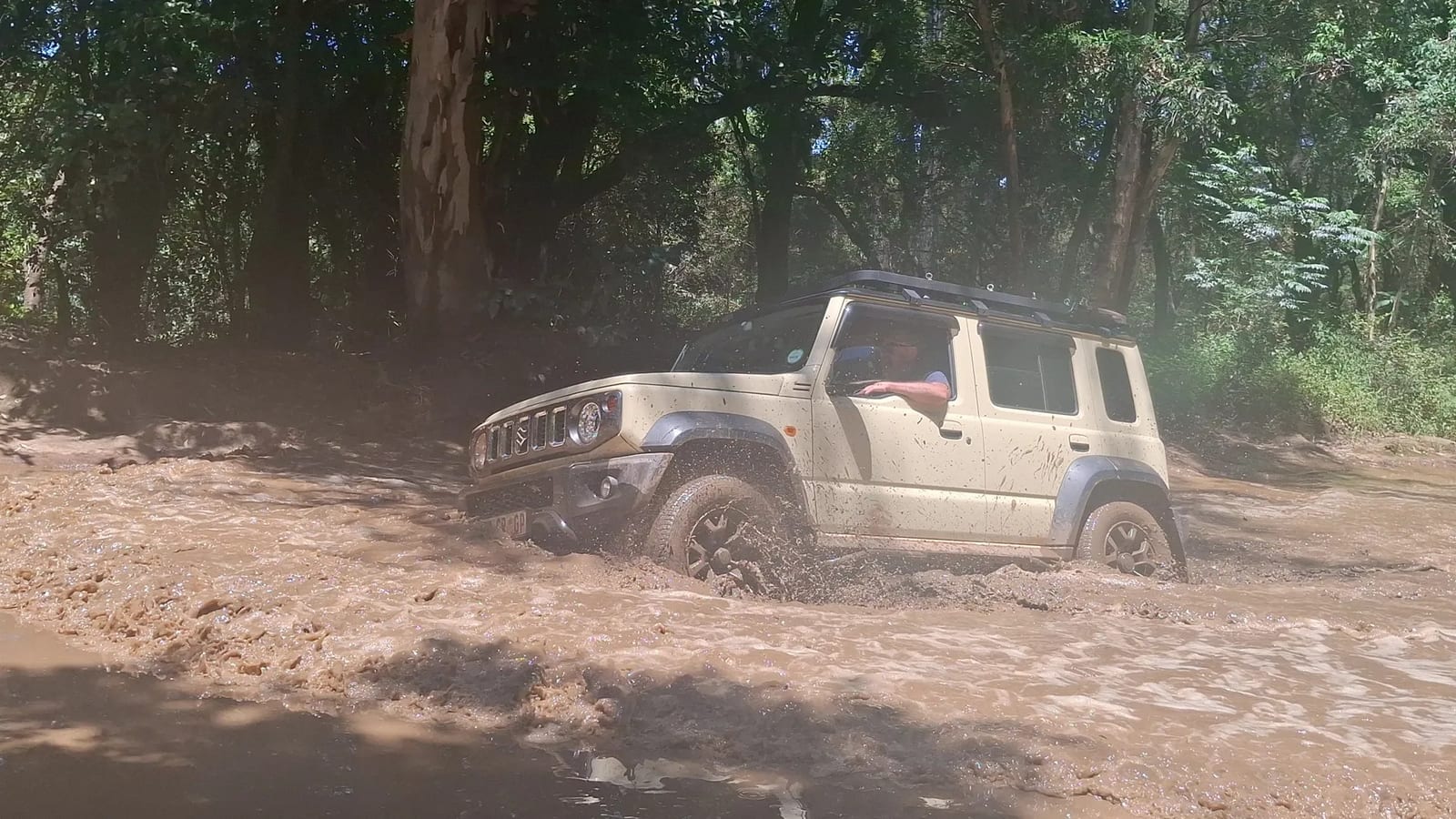
Deep water. Suzuki SA publishes no safe wading depth for the Jimny, so walk a crossing before you drive it. After deep water, have the diff oil checked. Many owners fit diff breathers, which let the axles breathe so water is less likely to get in.
Low range popping out. Two 3-door owners on the forum had the lever jump out of 4L. One settled down as the car wore in. Another suspected an aftermarket storage tray round the levers. Make sure nothing blocks the lever.
Make a good 4x4 better, cheaply
The standard car is already capable. So the first money should go on small, useful things, not a big lift.
- Tyres. The factory tyres are thin, and owners call them “biscuits”. Good all-terrains are the first real upgrade. Start with our all-terrain tyres guide and tyre size guide, which also covers pressures.
- Recovery points and gear. Proper rated points front and rear, and a pair of recovery tracks for sand.
- Diff breathers, if you do river crossings.
- Protection for the sills and underneath, if you drive rocky trails. See our rock sliders and bumpers guide.
- A lift, last, and only if the way you drive calls for one. Our lift kits guide explains why most owners don’t need one.
The best spend of all is a training day. Locals learn low range at De Wildt near Brits, Hennops and Groenkloof in Gauteng, and Ou Trekpad and Honingklip in the Western Cape. Clubs like Jimny Crew run training days and convoys.
Live prices · 4 October 2026
Recovery gear and diff breathers in stock now
7 in stock at 3 stores today, from R895 to R5 950. Typical price about R3 499.
The full range is on our recovery and snorkels page and our Jimny accessories guide.
3-door or 5-door off-road?
Both have the same frame, axles, engine, clearance and low range. The difference is length.
| 3-door | 5-door | |
|---|---|---|
| Breakover angle | 27 degrees | 24 degrees |
| Turning radius | 4.9 m | 5.7 m |
| Best at | Tight bush tracks and sharp crests | Side slopes, long gravel and touring |
| CAR’s pick | For trails | For daily use |
The 3-door is the purer trail car. But owners who have driven both say the longer 5-door is much steadier on a side slope. It also keeps a usable boot with people in the back. Our 3-door vs 5-door guide has the full comparison.
Who should buy one
| You | Our view |
|---|---|
| Want a proper 4x4 for weekend trails, passes and training days | Buy one. It is at its best slow and technical. |
| Drive to work in the week, trails on weekends | A good fit, if you accept a busy ride on the highway. |
| Tour far with a family and a lot of gear | Look at a bigger 4x4. |
| Need to tow more than a small trailer | Look at a bigger 4x4. |
| Cruise long distances at 120 km/h | Test drive it on the highway first, on a windy day. |
| Never leave tar | You don’t need the 4x4 hardware. |
One owner on the forum made the case against. He called the Jimny a compromised daily driver, and said most 4x4s never see the dirt they were bought for. He has a point. If you won’t use low range, you are paying in ride comfort and boot space for nothing.
The bottom line
The Suzuki Jimny is a real 4x4. It has low range, a solid axle at each end and a ladder frame, and every new one sold in South Africa has them. On slow, steep and rocky ground it keeps up with 4x4s that cost far more, because it is small, light and has steep angles.
It loses on power, fuel range, load, towing and long highway days. Know that going in, fit good tyres, do a training day, and keep the heavy stuff off the roof.
Ready to look? See what they cost in our Jimny price guide, browse every Jimny for sale, or check what yours is worth.
A big thank you to the people whose photos made this guide. Jimny Crew is the South African Jimny club that runs trail days, convoys and trips. Thanks too to 4x4 Afrika, Suzuki Auto South Africa and Suzuki Motor Corporation. Go and see their work.