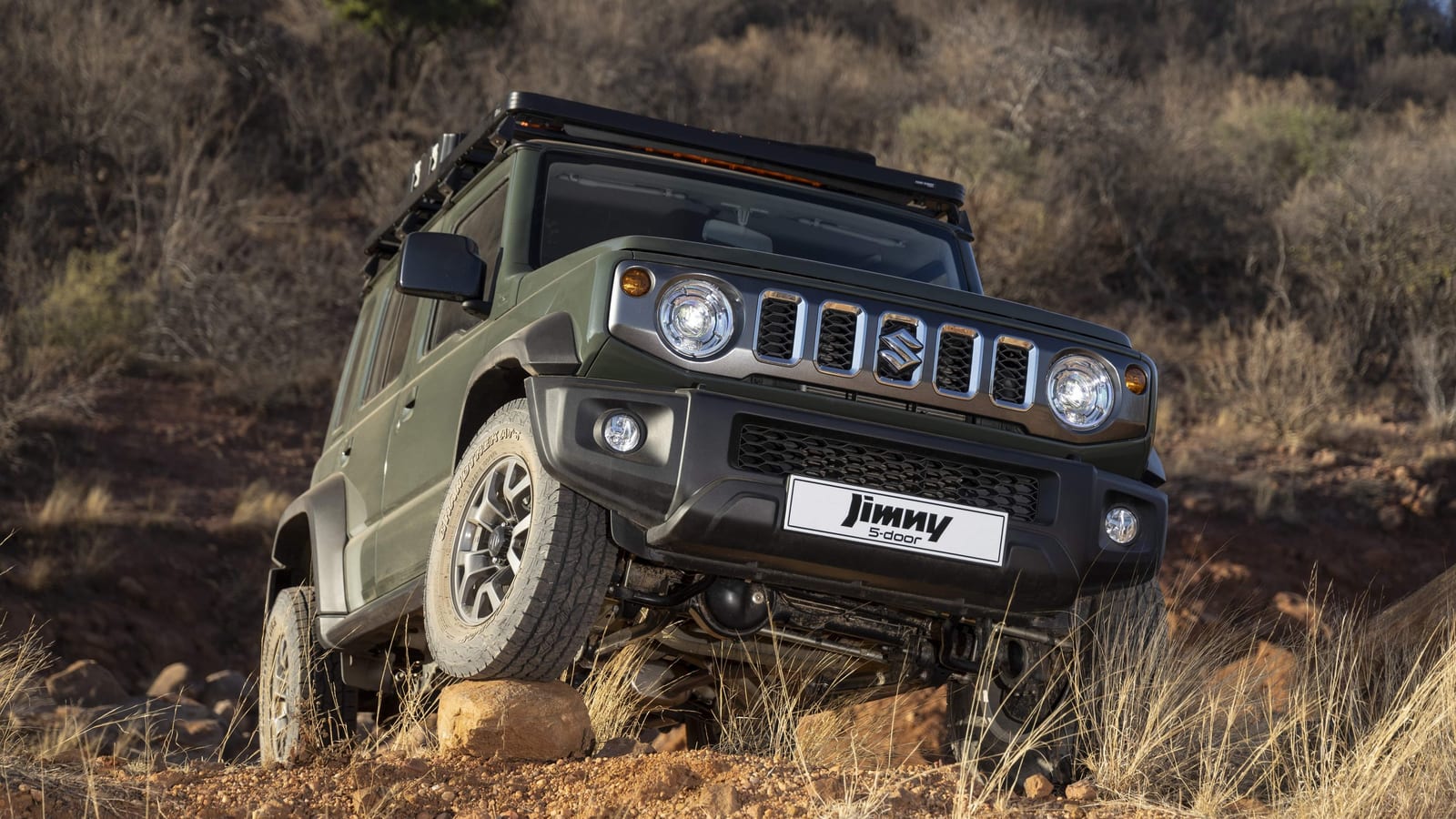
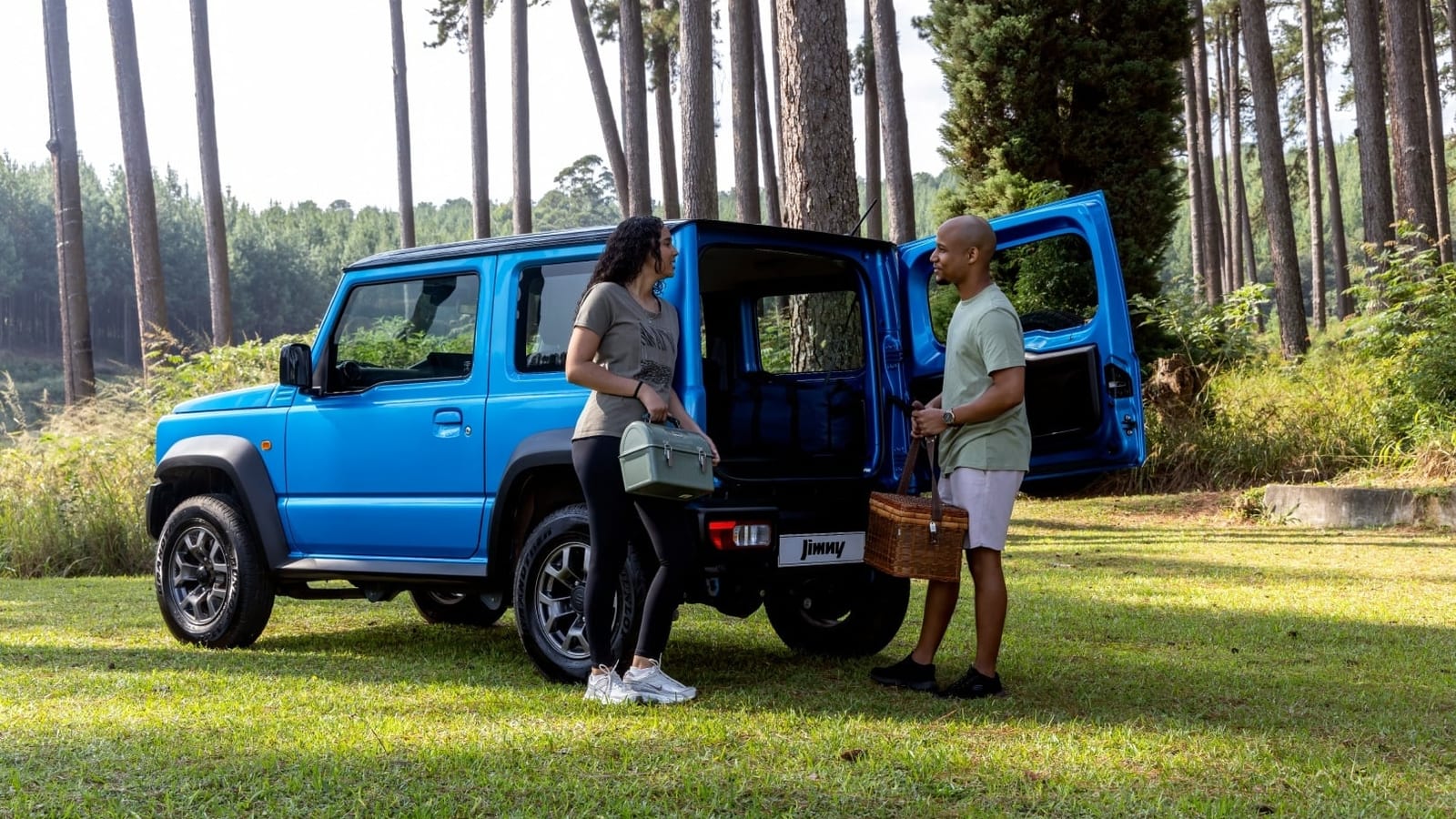
Cover photo: Suzuki Auto South Africa, from their Jimny 3-door pages. Thanks to the Suzuki SA team. This is the little car doing what it does best: getting two people out of town.
Two of you, a long weekend in the Cederberg, and a Jimny. You open the back door with the rear seats up. There is room for a school bag and the groceries, and not much more.
Suzuki Auto South Africa rates the 3-door’s boot at 85 litres with the seats up. The 5-door holds 211 litres. Those numbers are the start of the story, not the end.
Space is only half the problem. Weight is the other half. A Jimny carries far less than most people guess, and every box you bolt in uses some of it up.
So this guide works like a ladder. It starts free, then cheap, then serious. Each step costs more and weighs more than the one before. Most owners stop at a flat floor, a few crates and a fridge. You probably can too. Still choosing a body? Our 3-door or 5-door guide covers the rest.
The Jimny boot in real litres and kilograms
All of these figures come from Suzuki Auto South Africa’s brochures and spec pages for the current Jimny (2018 on).
| 3-door | 5-door | |
|---|---|---|
| Boot, rear seats up | 85 L | 211 L |
| Boot, rear seats folded | 377 L | 332 L |
| To the roof, seats folded | 830 L | 1,113 L |
| Seats | 4 | 4 |
| Empty (kerb) weight | 1,095 to 1,130 kg | 1,185 to 1,215 kg |
| Gross vehicle mass (GVM) | 1,450 kg | 1,545 kg |
| Payload (GVM minus kerb weight, our sum) | about 320 to 355 kg | about 330 to 360 kg |
Payload is the number that matters most in this guide. It is everything you add to the empty car. That means you, your passengers, your bags, your water, and every accessory bolted on. The GVM is the most the loaded car may weigh. Take away the empty weight and what is left is your payload.
Seats up, the 5-door’s boot is about two and a half times the 3-door’s. That is the real difference between the two.
Fold the seats and Suzuki’s own figures put the 3-door slightly ahead. That is an odd quirk of how the boots are measured. It does not make the 3-door the roomier car, so do not read much into it.
The weight line tells a different story. The 5-door carries only about 10 kg more than the 3-door. It has more room, but not more payload. It simply gives you more space to overload.
One small print note. Suzuki measures the 3-door’s 85 litres without the plastic luggage box under the boot floor. Many decks and drawers sit where that box lives. If you want to keep it, ask the store before you buy.
The older Jimny (1998 to 2018) has a smaller boot still. Suzuki SA no longer publishes its figures.
What the 5-door changes
TimesLIVE ran a 5-door as a long-term test car. They drove it from Joburg to Montagu, a trip of 1,396 km. Their finding was that the boot is fine for two people who pack light and use soft bags. With three people, one half of the rear seat had to fold. With four, they needed a roof box or a rack.
The 5-door’s rear seat splits 50:50. That helps a lot. You can fold one side for bags and keep the other for a passenger.
So if you drive a 5-door, you probably do not need a drawer. Soft bags, a pouch and maybe a cargo shelf will cover most trips. Our 5-door review has the rest of the story.
Step 1, free: fold the seats, or take them out
For two people, the first move costs nothing. Fold the rear seats and the 3-door goes from 85 to 377 litres.
Many owners go further and take the seats out. On the current Jimny that is easy. Owners on the 4x4 Community forum say it takes about half an hour. The seats go back in just as easily. On the older Jimny, some owners had to cut stuck bolts.
Before you do it, know the paperwork side. The National Road Traffic Regulations count changing the number of passenger seats as a modification. They also say a licence disc that no longer describes the car is void. The same goes for a roadworthy certificate.
How licensing offices treat seats sitting in your garage is not clear. So the safe advice is simple. Keep the seats and all the bolts. Put them back before a roadworthy test or a sale.
Keep them for resale too. A 3-door without its back seats has lost half its seats.
For a Gauteng daily driver, our reading is that a weekend routine works best. Seats out on Friday, seats back in on Sunday night for the week. The current Jimny makes that easy.
Step 2, pocket money: nets, rings, pouches and the roof
These are the cheapest fixes, and most of them weigh almost nothing. Prices are from the stores on 23 September 2026.
| Product | Fits | Price | Store |
|---|---|---|---|
| Rear luggage attachment rings | 3-door (current) | R99.99 | JimSA |
| Rear cargo net | 3-door and 5-door | R349 | JimnyworX |
| Rear luggage pouch | 3-door / 5-door | R544.99 / R565 | JimSA |
| 5-door rear seat storage | 5-door | R780 | JimnyworX |
| MOD cargo hammock | 3-door / 5-door / older Jimny | R820 / R985 / R820 | JimSA |
| Front Runner internal storage shelf (2.74 kg, holds 20 kg) | current Jimny | R2,700 | JimnyworX |
| Alu-Cab in-cabin cargo rack (4 kg, holds 15 kg) | 3-door (current) | R4,520, made to order | JimnyworX |
| Predator interior Molle rack (holds 25 kg) | 5-door | R4,000 | JimnyworX |
JimSA’s attachment rings screw into clip holes that are already there. The pouches need no tools at all. Nothing here changes the car on paper.
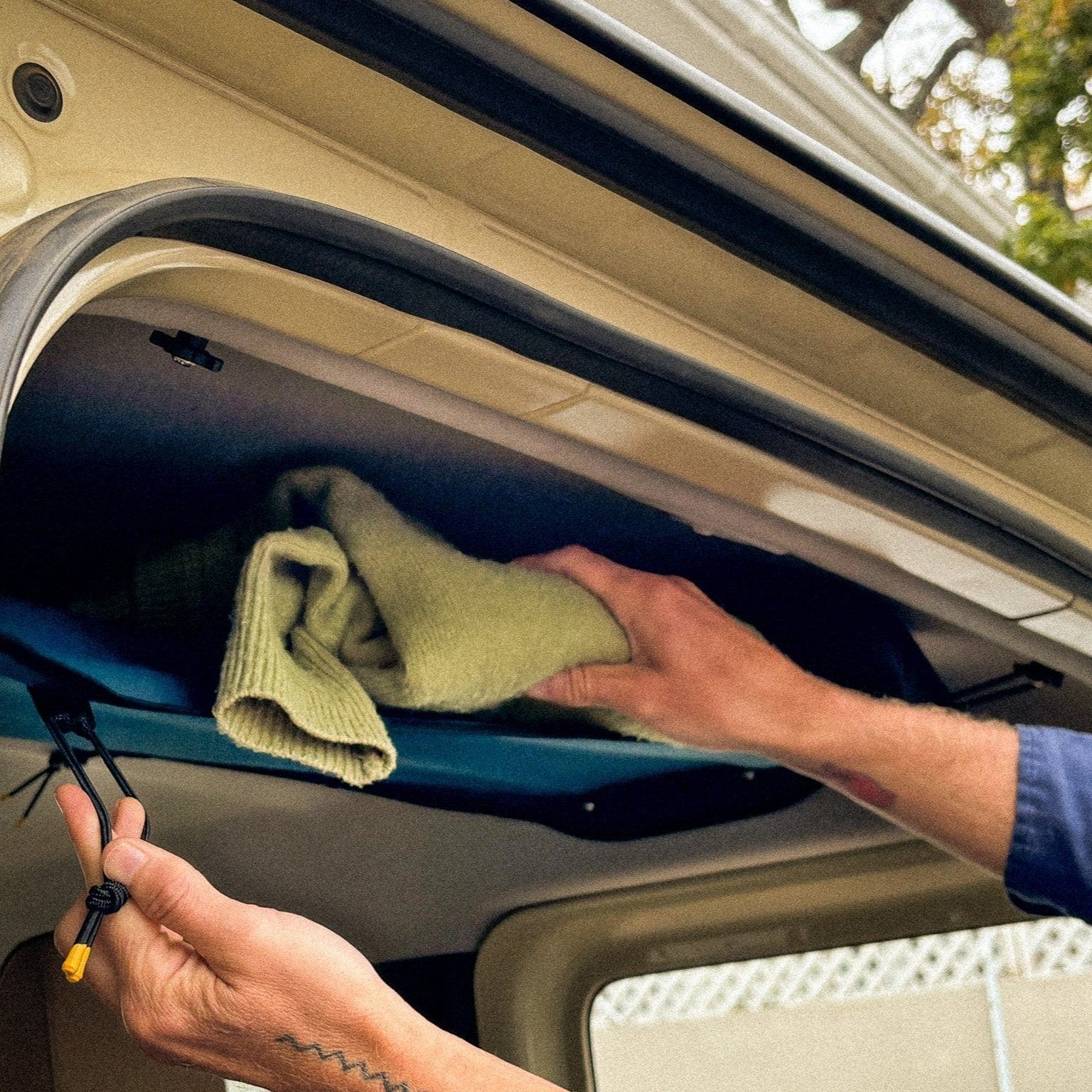
The space under the roof is empty in almost every Jimny. A cargo hammock puts it to work. MOD’s hammock weighs 400 grams. It is made in Cape Town by a couple who designed it after a long Namibia trip in their own Jimny. Its straps unclip, so people can still ride in the back.
The racks under the roof lining are stronger. They are rated for 15 to 25 kg. Even so, put only light, bulky things up there, like jackets and sleeping bags. Keep heavy things low. A Jimny is tall and narrow, and weight up high makes it lean more in corners.
The cargo net is also a safety item. Pack below the window line so you can still see out the back. The road rules say a load must not block your view to the rear, and it must be held in or tied down. A net stops loose things flying forward if you brake hard.
Live prices · 4 October 2026
Nets, pouches and hammocks in stock right now
5 in stock at 2 stores today, from R100 to R780. Typical price about R545.
Step 3, the big one: a flat floor
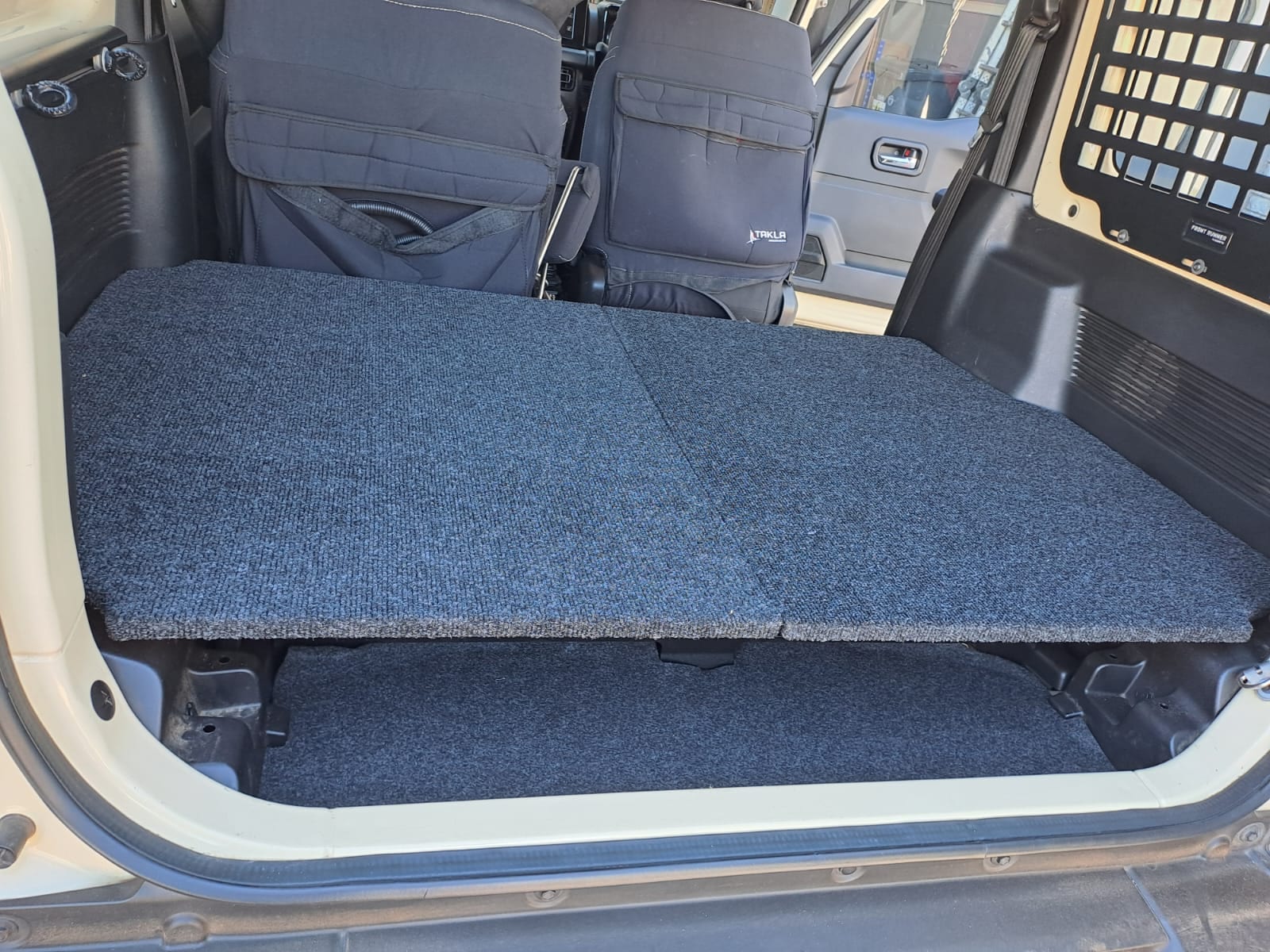
A base deck is a flat, carpeted board that bolts in where the rear seats sit. It turns the lumpy back of a Jimny into one level floor. Crates slide in, the fridge sits flat, and nothing rolls into the gaps.
| Product | Fits | Seats | Weight | Price | Where |
|---|---|---|---|---|---|
| Front Runner cargo base deck | 3-door (current) | out | 7.9 kg | R2,700 | JimnyworX, Front Runner |
| Front Runner rear seat base deck | 3-door (current) | stay in | not stated | R3,800 | JimnyworX |
| Front Runner cargo base deck | 5-door | out | 8.3 kg | R3,200 | JimnyworX, JimSA, Front Runner |
| The Camper Company base board (18 mm birch ply) | 3-door, current and older | out | not stated | R3,800 | JimnyworX |
| JimnyworX GL and GA boot box | 3-door GL and GA | stay in | not stated | R2,199 | JimnyworX |
| Zombie Offroad boot box | older Jimny | stay in | not stated | R1,995 | Zombie Offroad |
This is where most owners should stop. For under R4,000 you get a flat floor. Front Runner’s decks weigh under 9 kg. With the seats out, Front Runner’s 3-door deck gives you a floor of about 830 by 920 mm.
Watch for one trap. Front Runner makes two decks for the 3-door. One needs the seats out and costs about R2,700. The other lets the seats stay in and costs about R3,800. They look alike online, so read the product title twice. Decks for the 3-door and the 5-door do not swap either.
GL and GA owners have their own option. JimnyworX says these models do not come with the underfloor box that the GLX gets. Its boot box fills that gap. It gives a flat floor and hidden space with the seats still in, for about R2,200.
Doing it yourself is still normal. Owners have laid marine ply or carpeted chipboard on the seat mounts for years. The best tip from the forums is to mock it up in cardboard first. Cardboard is cheap and wood is not.
Live prices · 4 October 2026
Base decks, Molle panels and shelves in stock right now
14 in stock at 2 stores today, from R236 to R3 800. Typical price about R2 700.
Step 4, go up the walls: Molle panels and gullwings
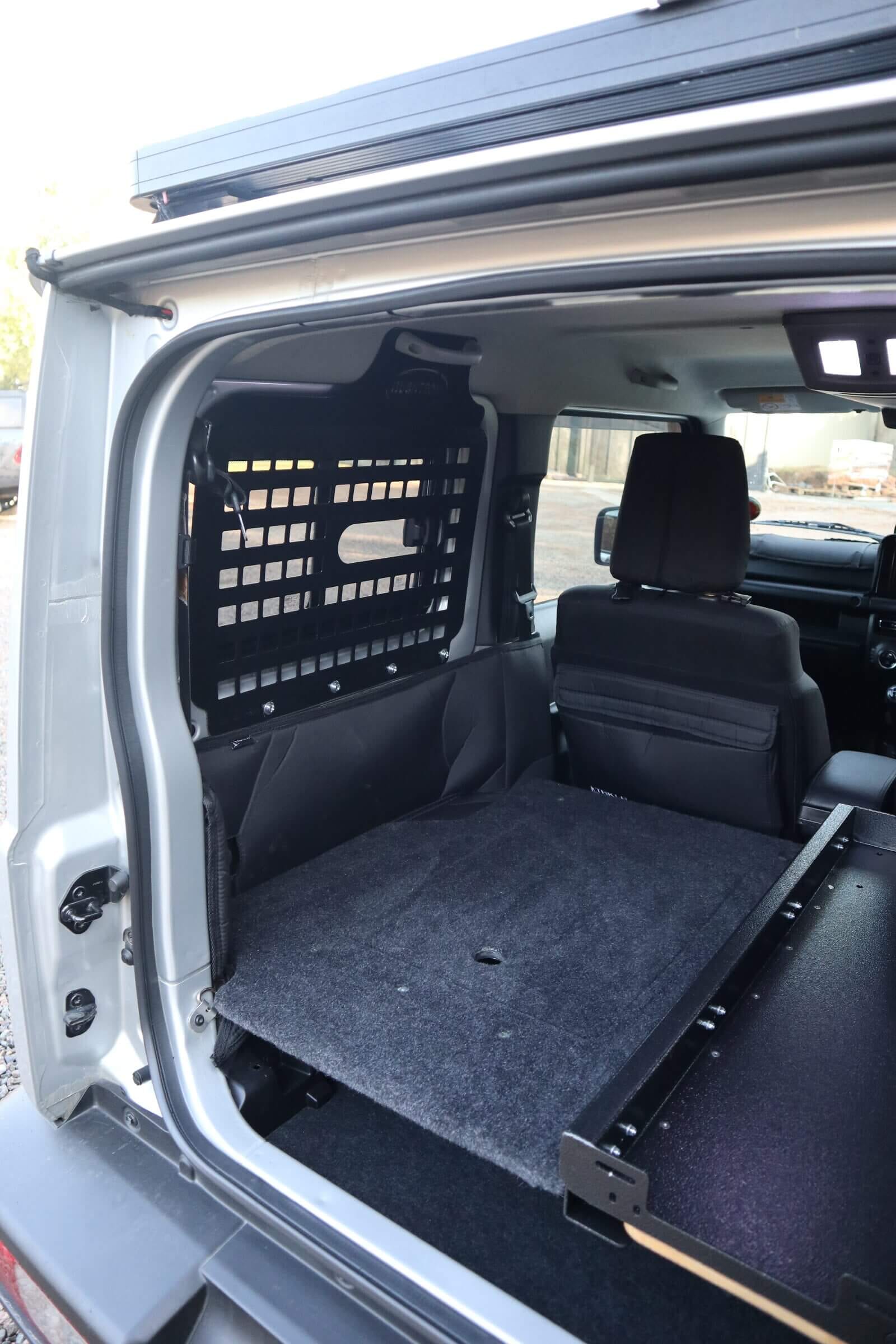
Molle is a grid of webbing slots that started in the army. Bags and pouches clip onto it wherever you like. In a Jimny, Molle panels cover the small rear side windows.
| Product | Fits | Weight | Price | Where |
|---|---|---|---|---|
| Molle panel bag, small / medium | fits the panels | not stated | R236 / R249 | JimSA |
| Front Runner rear window Molle panel | 3-door (current) | 3.7 kg | R1,500 | JimnyworX, JimSA |
| JimnyworX interior Molle plate, per side | 3-door (current) | 1.7 kg | R1,980 each | JimnyworX |
| MOD Half Molly set | 5-door | not stated | R1,200 | JimSA |
| 5-door window storage Molle panel kit | 5-door | not stated | R2,999 | JimnyworX |
| Gullwing window (JimnyworX, made in SA), per side | 3-door | 5 kg | R6,900 | JimnyworX |
| Bushtech gullwing, per side | 3-door (current) | not stated | R6,900 | JimSA |
| Bushtech storage cupboard for the gullwing | 3-door (current) | not stated | R2,530 | JimSA |
A panel with two small bags keeps the daily things in reach. Think torch, tyre gauge, first aid kit and cable ties. Front Runner says its panel is made locally.
A gullwing is the bigger step. It replaces the fixed rear side window with a lockable aluminium hatch that lifts up. You reach into the boot from the side. That helps when a bike rack or a spare wheel is in the way of the back door. Bushtech, a family firm in Johannesburg, designs and makes theirs in South Africa. It also sells a storage cupboard that fits inside the hatch.
Gullwings are sold per side, and the left and right ones do not swap. Doing both sides costs about R13,800 before the cupboard. There is also a cost you only notice later. That window is now metal, so you lose that view for good.
We found no gullwing for the 5-door at the six stores we track. That does not mean none exist.
Why do South Africans care so much about lockable hatches? Smash and grab. Overseas, a Molle wall is often about showing off your kit. Here, the smart move is keeping it out of sight. Zombie Offroad sells its older-Jimny boot box on exactly that point. Dust is the other local enemy on gravel roads, and sealed boxes help. Our common problems guide covers dust getting into the boot.
Step 5, for the committed: drawer systems
Drawers mostly come from specialist makers, not from the stores we track. Not one of the 658 accessories we follow has “drawer” in its name. The makers are local. Big Country has made drawers in South Africa since 2005. The Camper Company is in Somerset West, and Alu-Cab is in Cape Town.
| Product | Fits | Seats | Empty weight | Price | Where |
|---|---|---|---|---|---|
| Big Country Savute single drawer | 5-door | not stated | 55 kg | R11,999 | Big Country |
| Big Country Savute single drawer and ammo box slider | 3-door (current) | out | 50 kg | R16,999 | Big Country, JimnyworX |
| Big Country Savute single drawer and ammo box slider | 5-door | not stated | not stated | R19,999 | JimnyworX |
| Big Country Savute twin drawer | 3-door (current) | not stated | 55 kg | R20,999 | Big Country |
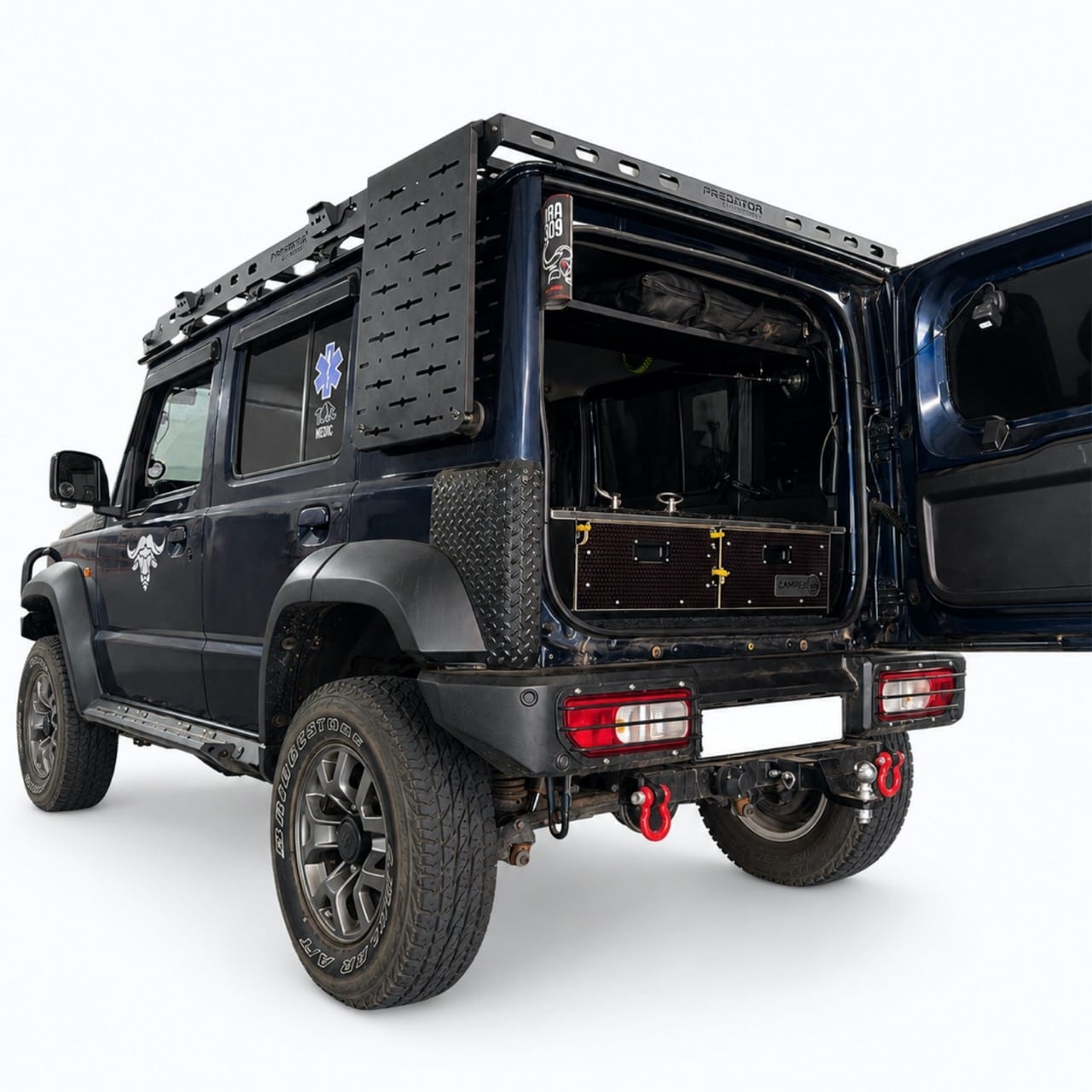
| The Camper Company “Jimmy” (two drawers, built-in fridge slide) | 3-door, current and older | out on the older Jimny | 37.5 kg | R21,900 (R24,500 at JimnyworX) | The Camper Company, JimnyworX |
| The Camper Company “Jimmy 5-Door” | 5-door | out, base board needed | 43.5 to 47.5 kg | R24,500 (R28,300 with base board) | The Camper Company |
| Alu-Cab Jimny drawer system | 3-door (current) | out | about 30.7 kg, plus a frame sold separately | ask Alu-Cab | Alu-Cab |
The good part is real. Big Country’s drawers lock with a key, which matters when you stop at a padstal. Everything has a place, so you stop unpacking the car to find the braai tongs. The Camper Company builds a fridge slide into its drawers for both bodies.
The cost is real too. A drawer weighs 30 to 55 kg before you pack a thing. And the seats have to go.
Here is the line to remember: the drawer can hold more than your Jimny can. Big Country rates its 5-door drawer at 150 kg per drawer. It rates the top at 250 kg. The whole car’s payload is only about 330 to 360 kg, and that includes you. A drawer’s rating tells you the drawer is strong. It does not tell you what the car can carry.
All that weight also sits behind the rear axle. That changes how the back of the car rides. Our lift kits and suspension guide and the suspension section cover that side.
A few practical points. JimnyworX says The Camper Company unit also needs tie-down rings and rear door struts that open to 90 degrees, and these are not included. JimnyworX also warns that there can be a wait. No SA magazine has tested a Jimny drawer yet, so lean on the makers’ specs and owner reviews.
Fridges and fridge slides
A fridge slide lets the fridge roll out past the back door to waist height. No more climbing into the boot to find the milk.
| Product | Fits | Weight | Rating | Price | Where |
|---|---|---|---|---|---|
| Bushtech heavy-duty cargo and fridge floor slide | 3-door (current) | 17 kg | 180 kg | R9,775 | JimSA |
| Bushtech mounting frame (needed for the slide) | 3-door (current) | not stated | not stated | R4,485 | JimSA |
| Slide and frame together | 3-door (current) | about R14,260 | JimSA |
Bushtech’s slide locks out on uneven ground and comes with a 2 year warranty. It needs the mounting frame, so budget for both. The other route is a drawer with the slide built in, like The Camper Company’s.
Before you buy anything, measure. Measure your fridge, the slide and the door opening. The Camper Company’s advice is to leave room for the plug, the latches and the handles. SA owners mostly talk about National Luna, Snomaster, Engel and Indel B. Check the size of your own fridge against the slide, not the brand name.
One more thing. A fridge that runs overnight needs a second battery. SA forum owners have learnt that the standard battery will not run a fridge with the engine off.
Live prices · 4 October 2026
Fridge slides in stock right now
3 in stock at 1 store today, from R4 485 to R9 775. Typical price about R6 900.
Rear door tables
| Product | Fits | Weight | Holds | Drilling | Price | Where |
|---|---|---|---|---|---|---|
| MOD rear door table | current, 3 and 5-door | 3.8 kg | 15 kg | no | R2,850 | JimSA |
| Front Runner drop down table | current, 3 and 5-door | 7.8 kg | 20 kg | yes | R3,000 | JimnyworX, JimSA |
| JimnyworX Gen 4 rear drop down table | current | 6 kg | not stated | not stated | R4,899 | JimnyworX |
| Alu-Cab rear drop down table | current 3-door | 8.5 kg | 12 kg | not stated | R5,520, made to order | JimnyworX |
| MOD rear door table | older Jimny | not stated | not stated | not stated | R1,650 | JimSA |
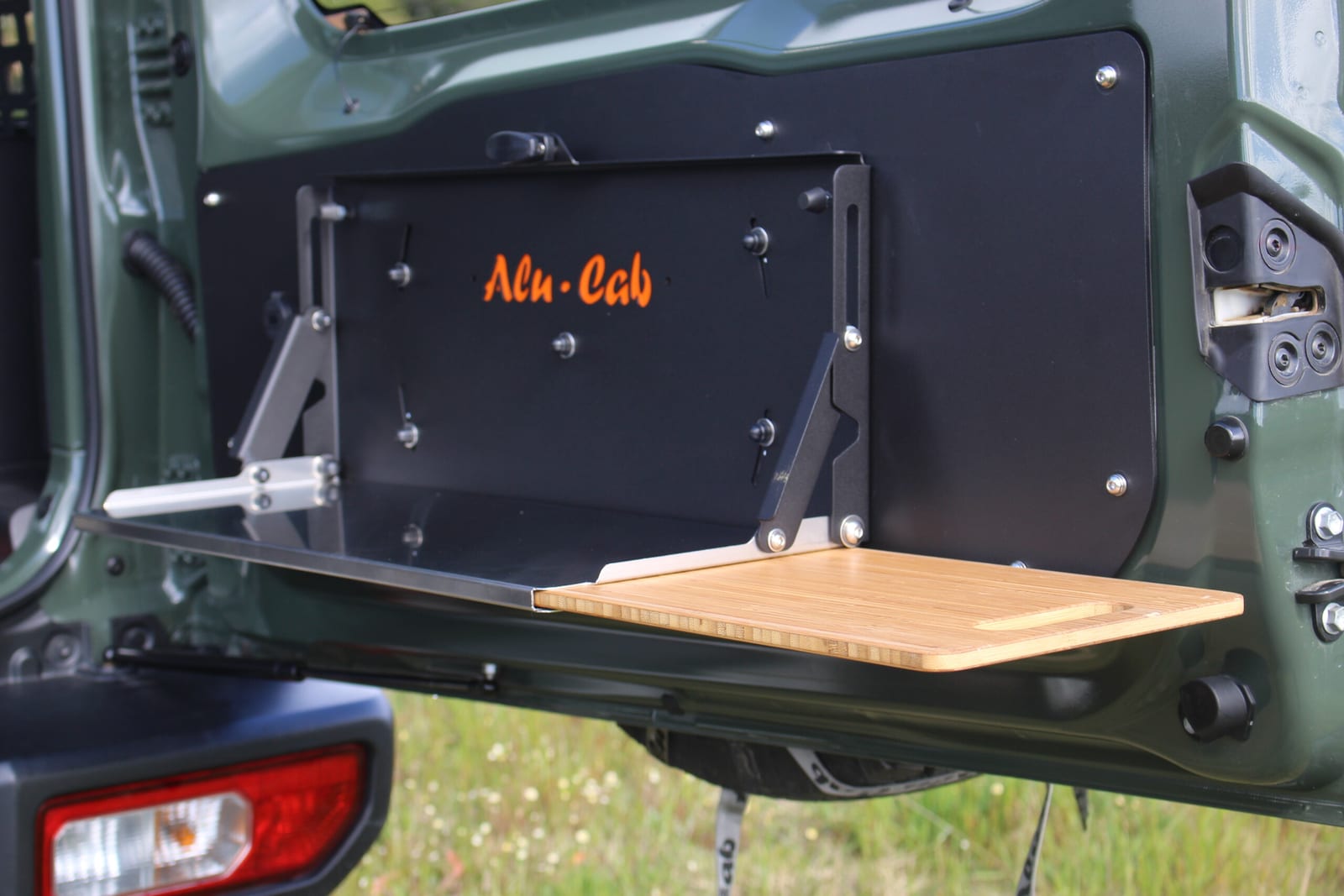
A table on the back door takes no boot space at all. Pull over at a Cederberg lay-by and the kettle is on in 30 seconds. MOD’s table needs no drilling. Front Runner’s does. If you plan to drill, ask your dealer first (more on warranty below). We found no door load limit from Suzuki, so treat the table as a counter, not a shelf.
Packing a 3-door for a weekend away
Take a 3-door manual at the heavy end of the range. Suzuki gives it a GVM of 1,450 kg. It weighs about 1,110 kg empty. That leaves about 340 kg of payload. Here is where it goes.
| With a base deck | With a Big Country single drawer | With a Big Country twin drawer | |
|---|---|---|---|
| Payload | about 340 kg | about 340 kg | about 340 kg |
| Two adults (our guess: about 80 kg each) | 160 kg | 160 kg | 160 kg |
| The storage itself | 7.9 kg | 50 kg | 55 kg |
| 20 litres of water | 20 kg | 20 kg | 20 kg |
| Left for fridge, food, tent, bedding, recovery kit and clothes | about 152 kg | about 110 kg | about 105 kg |
That is before any bumper, rock sliders or roof rack, and they all count too. Our rock sliders and bumpers guide covers what they weigh. Weigh your fridge once it is full of food and drinks. It is heavier than you think.
SA owners have packed small Jimnys this way for years. Most of the forum threads are about the older car, but the logic carries over:
- Heavy things go low and forward: water, gas, tools and the fridge.
- Light, bulky things go high: bedding in the hammock or a light roof bag.
- Daily things go where you can reach them: Molle bags and seat-back pouches.
- Keep the jack and tools where you can get them without unpacking.
- If it does not fit, it stays home.
One Underberg owner on the forum shows how far this goes. His seats are out for good. He built a ply box with a hinged shelf, and packs a 40 litre fridge and five plastic boxes on top. Mattresses and sleeping bags ride in a roof box.
Be careful with the roof, though. It takes far less weight than most people think. Suzuki SA’s 5-door brochure gives 30 kg, and that includes the rack. Our rooftop tent guide does the maths, and our roof racks guide covers the racks. A small trailer is the other way out. The 3-door is rated to tow a braked trailer of up to 1,300 kg, as our towing guide explains.
The paperwork: insurance and warranty
Insurance. A drawer and a pair of gullwings are exactly the things thieves take. Make sure your insurer knows about them. OUTsurance, for one, only covers non-standard accessories that are listed on your policy schedule, and you pay extra for that. Other insurers have their own rules, so ask yours.
Warranty. Suzuki SA says non-genuine accessories could affect your warranty. The Competition Commission’s rules, in force since July 2021, say fitting non-original parts is your right. A carmaker may only refuse the part of a claim that the fitted part caused. Most storage bolts to points that are already there. The real risks are drilled holes and wiring in a fridge socket. Ask your dealer before you drill.
What to buy, by budget
| You | Buy | Spend |
|---|---|---|
| Daily driver, keeps all four seats | Cargo net, attachment rings, seat-back pouch, MOD hammock | about R350 to R1,800 |
| Couple, weekends away, 3-door | Seats out and a Front Runner base deck (or the seats-in deck), a few plastic crates, a Molle panel and bags | about R4,700 to R5,800, plus crates |
| GL or GA 3-door, seats stay in | JimnyworX GL and GA boot box | about R2,200 |
| 5-door owner | Probably nothing big. A pouch, a hammock, maybe a rear cargo shelf (Front Runner R2,599.99 at JimSA, or JimnyworX’s steel one at R3,799) | about R600 to R3,800 |
| Camps from the car often, 3-door | A deck, a Molle panel on one side, a gullwing with its cupboard on the other, a door table | about R16,500 to R18,000 |
| Long trips (Namibia, Botswana, the Kgalagadi), seats gone for good | A drawer system, ideally one with a fridge slide | about R12,000 to R28,300 |
| Older Jimny (1998 to 2018) | Zombie boot box or MOD caddy box (R2,100 at JimSA), MOD hammock, MOD door table | about R820 to R4,600 |
The rule is simple. Start at the top of this guide, and stop the moment packing stops being a fight.
For a lot of owners, that moment comes early. Seats folded, the 3-door already has 377 litres. A net, a hammock and soft bags handle most weekends. A drawer in a car that carries a friend twice a month is a bad trade: you lose the seats and a big slice of payload for neatness.
If you are still shopping for the car itself, and the boot is the worry, look at a 5-door. Every Jimny for sale in South Africa is on our listings page, with asking prices analysed daily. For everything else you can bolt on, start at our accessories page or the Jimny accessories guide. The full storage list, with today’s prices from six stores, is on the storage and interior page. Heads up: that page also holds mats, seat covers and trim, so only about a third of it is real storage. Fridge slides sit under rooftop tents and camping, and the in-cabin racks sit under roof racks.
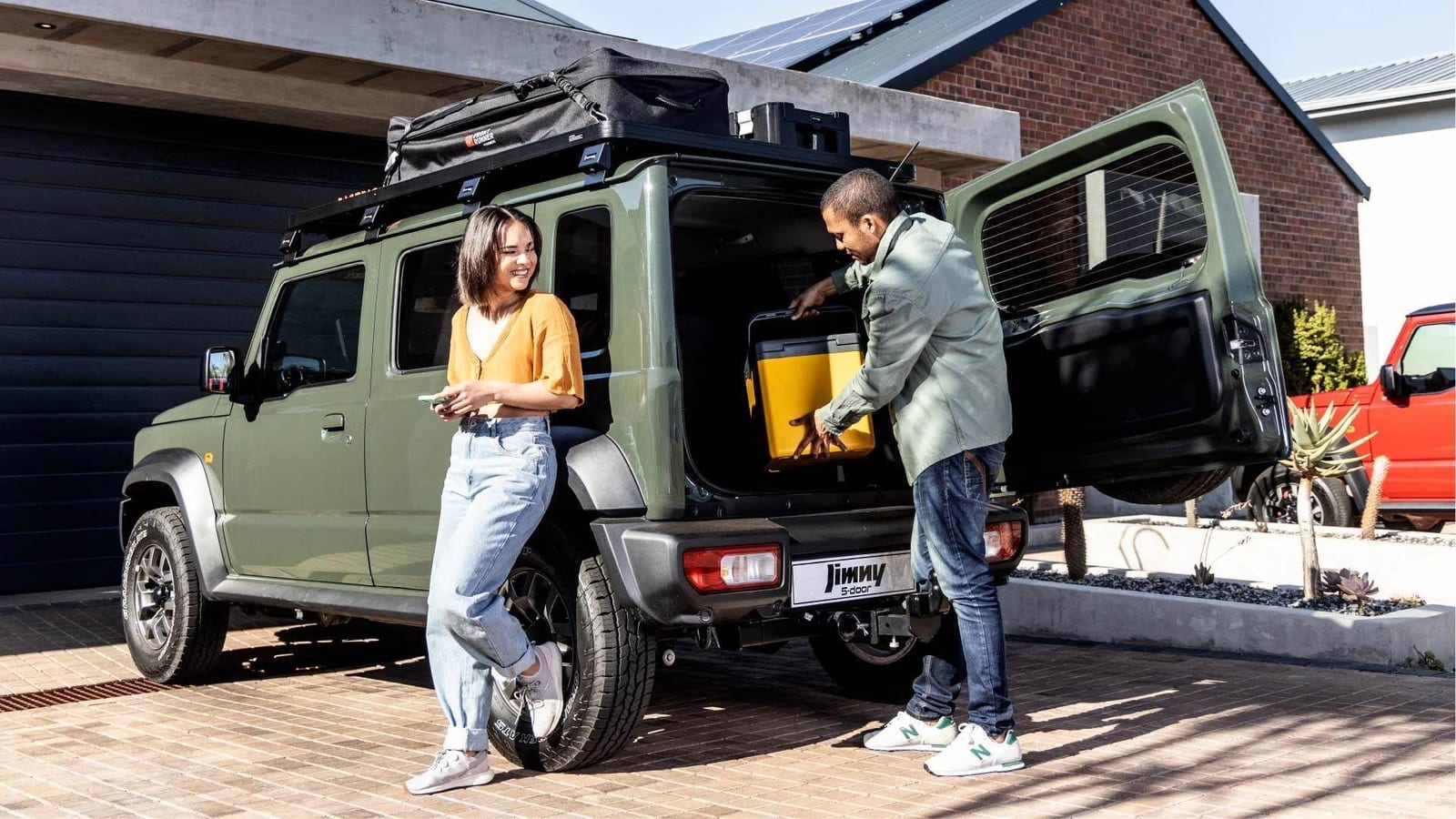
A big thank you to everyone whose photos made this guide. Suzuki Auto South Africa made the cover and the 5-door shot. The deck, Molle and table photos are from JimnyworX SA. Alu-Cab makes the table itself. The Camper Company built the 5-door drawers. The hammock photo is from MOD, via JimSA. Local makers building for local roads: go and give them your support.