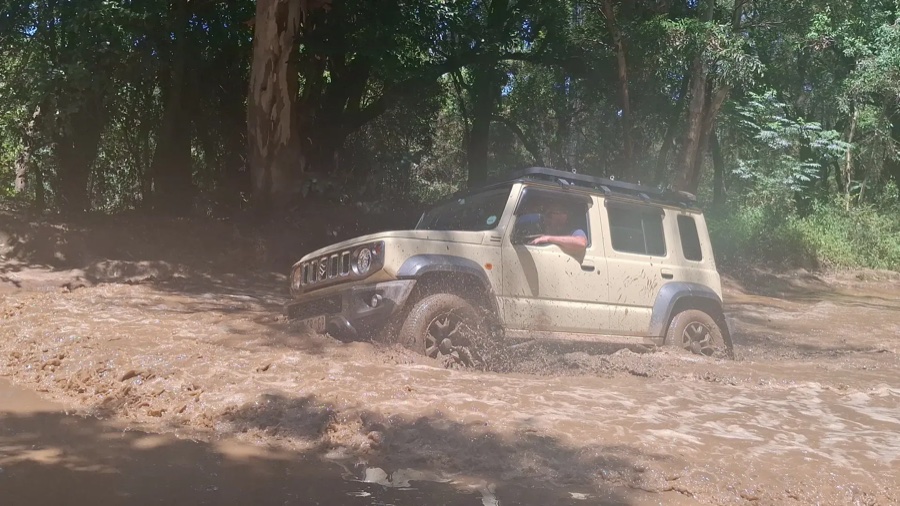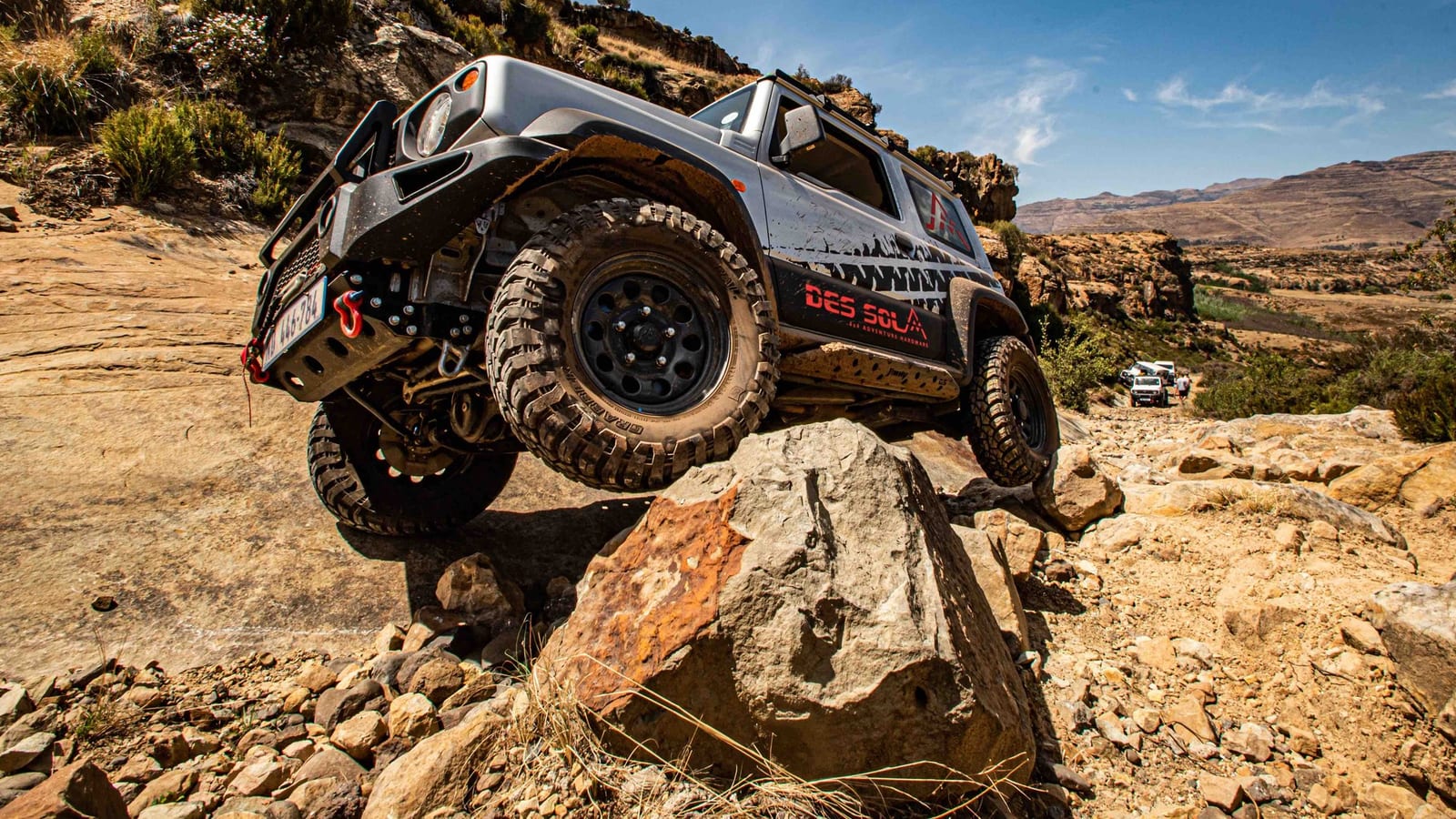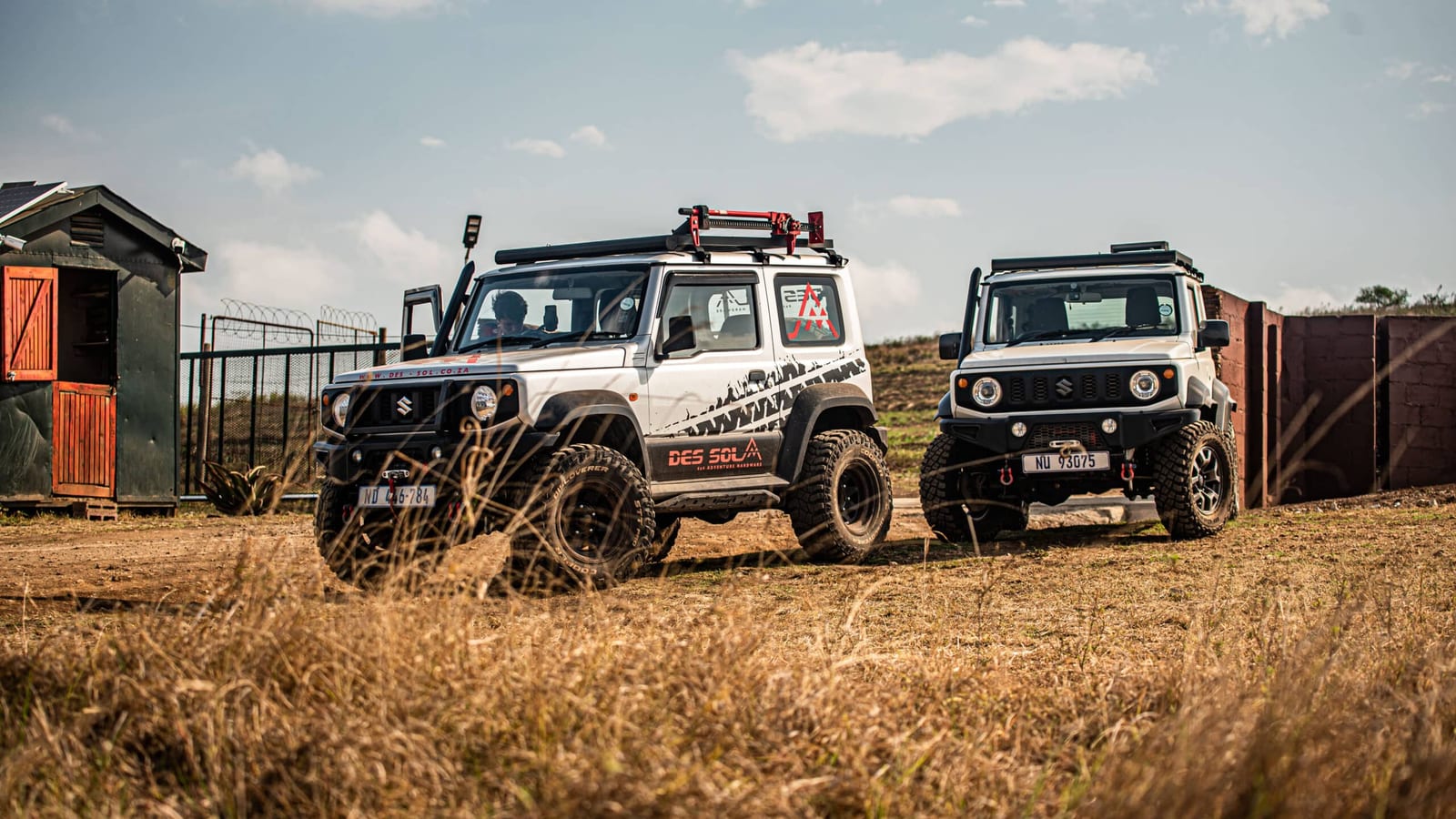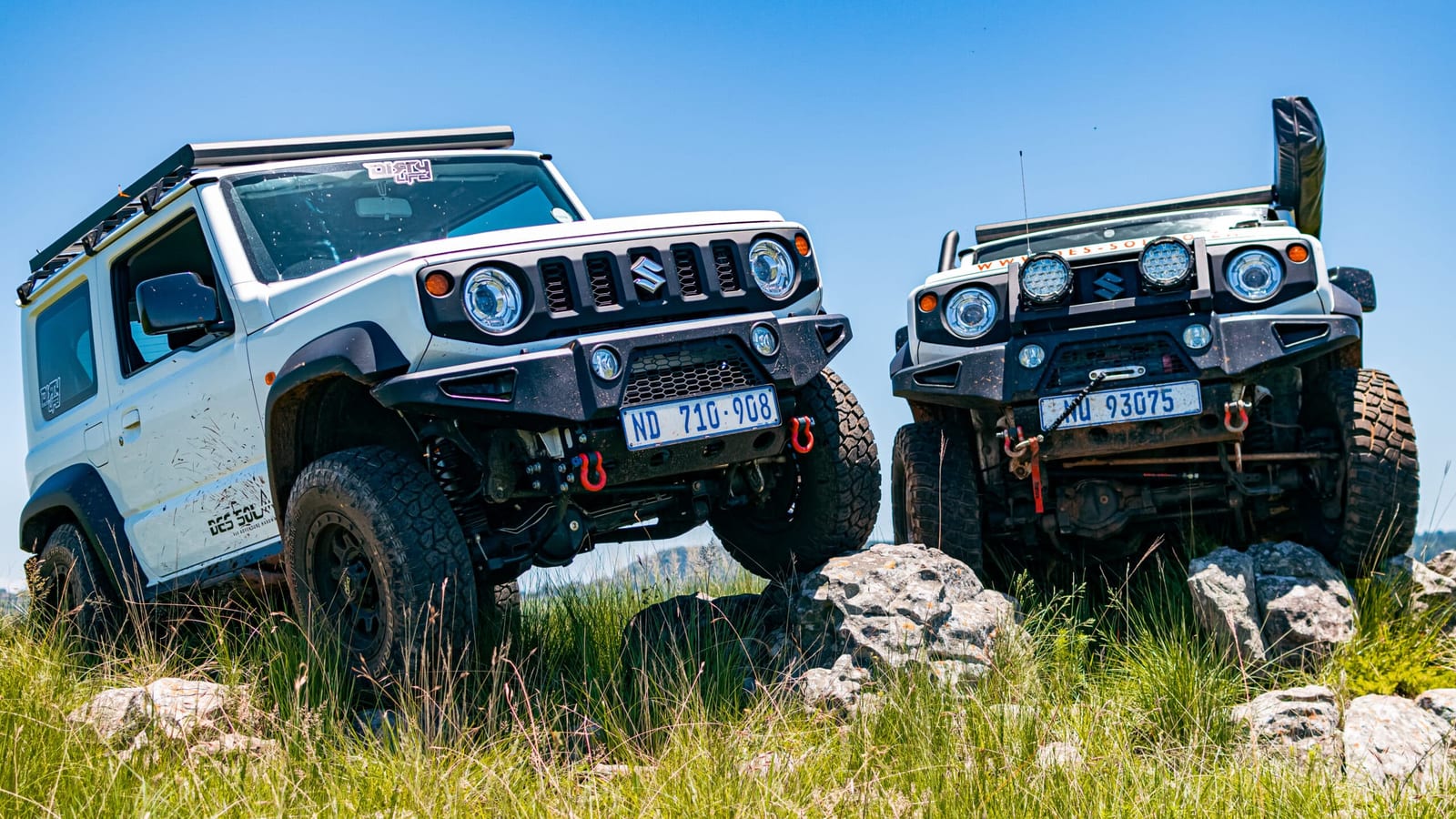
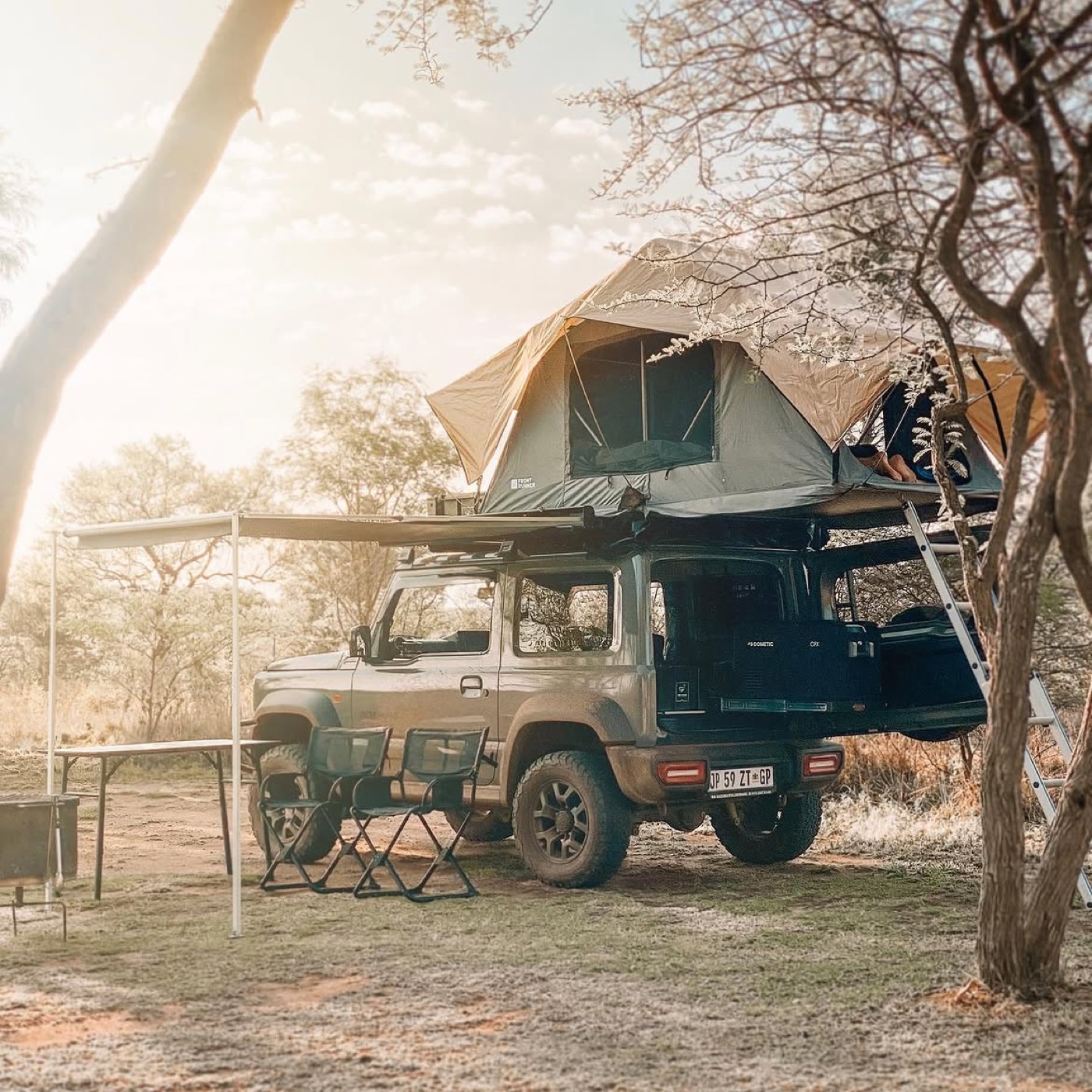
Cover photo: a Front Runner tent on a 3-door Jimny in the bush, by Roaming Horizons. They make Jimny gear at roaminghorizons.co.za and take photos like this one. Go and give them a follow.
A Jimny with a rooftop tent is all over Instagram, and owners meet them at Mata Mata in the Kgalagadi. Yet ask the forums “can I fit a roof tent?” and you get the same first reply. Be sure you really want one, because a Jimny gets top heavy fast.
Both camps are right. People tour for years with a tent on a Jimny. The ones who do it well drive differently. And nobody gets to pretend the roof figure is higher than it is.
On the forums it is a roof top tent, or just an RTT. Whatever you call it, this guide gives you the figure and the maths. It lists the lightest tents sold in South Africa, with today’s prices. And it covers the options that keep the weight off the roof.
The short answer
- Can a Suzuki Jimny carry a rooftop tent? Yes, and owners do. But every tent and rack we found puts you over Suzuki’s figure.
- The figure: 30 kg on the roof, rack included, from Suzuki SA’s 5-door brochure. There is no published 3-door figure.
- The lightest tent: the RoofPod SoloPod, at 30 kg, sleeps one. For two, the RoofPod CoziPod is 40 kg.
- The cheapest light tent: the Front Runner Roof Top Tent, 43 kg, R15,399 at JimnyworX.
- The smarter options: a ground tent, Suzuki’s own car-side tent, or a tent on a trailer.
- Not sure yet? Hire a Jimny with a tent for a trip before you spend R25,000 or more.
The number that decides everything: 30 kg
Suzuki SA’s 5-door brochure gives a maximum roof load of 30 kg. The small print says that includes the rack and every carrier on it. So the rack counts. So do the brackets, the ladder and the tent.
The 3-door brochure gives no figure at all. Ask your dealer if you own a 3-door.
| Situation | What counts | Suzuki SA’s figure |
|---|---|---|
| Driving | The tent, the rack, and everything else on the roof | 30 kg (5-door brochure) |
| Parked, with you asleep up top | The same, plus the people and bedding | Not published |
On the forums you will see other numbers: 35 kg, 60 kg, even 100 kg from a dealer. Some come from rack makers. Some come from a tent’s own rating. None of them is Suzuki’s figure.
A tent’s own rating is easy to misread, too. Alu-Cab’s tents come with ratings for what the tent itself can carry. They are figures for the tent, not for your Jimny.
Stiffer springs do not change Suzuki’s figure either. Cloud Camper, a Johannesburg tent seller, says so on its own product page. It warns Jimny buyers that its tent plus a rack may go over the roof rating, even with upgraded suspension. Good on them for printing it.
Why does Suzuki set the figure so low? Suzuki does not say. The likely reason is that weight up high works against a narrow, tall car in every corner and gust. Sleeping in a parked tent is a different load. But Suzuki publishes no parked figure, so we will not invent one.
The roof maths
Here is what the roof carries while you drive, with the lightest tents first. Tent weights are as each maker states them. Bars are about 5 to 6.3 kg a pair, and full racks are 22 to 38 kg. Our roof racks guide has every rack weight.
| Setup | Tent | Carrier | Roof total | Over 30 kg by |
|---|---|---|---|---|
| Lightest, one sleeper | RoofPod SoloPod, 30 kg | Load bars | about 36 kg | about 6 kg |
| Lightest two-sleeper | RoofPod CoziPod, 40 kg | Load bars | about 46 kg | about 16 kg |
| Slim hard shell | Alu-Cab LT-50, 46 kg (51 kg with mattress) | Load bars | about 51 to 57 kg | about 21 to 27 kg |
| Budget big brand | Front Runner Roof Top Tent, 43 kg | Three-quarter rack, 22 kg | about 65 kg | about 35 kg |
| Big-brand tent on a full rack | Front Runner Roof Top Tent, 43 kg | Full rack, 27 kg (3-door) or 38 kg (5-door) | about 70 or 81 kg | about 40 or 51 kg |
| Typical SA canvas tent | Tentco or Howling Moon 1.4 m, 56 kg | Full rack, 24 to 38 kg | about 80 to 94 kg | about 50 to 64 kg |
Every setup is over. The question is by how much.
Weights are not measured the same way, so check what each one includes. The RoofPod and LT-50 weights leave out the ladder. The LT-50’s 46 kg also leaves out its mattress, which adds about 4.5 kg. The Front Runner Feather-Lite II’s 49 kg includes its ladder and cover. Ask every seller for the weight as it will sit on your roof.
Then add what you leave inside the tent: bedding and pillows. Add anything on the tent’s lid, too. A RoofPod lid can carry up to 20 kg of solar panel or recovery tracks. That is the pod’s own rating, and every kilo on it counts against your roof.
What the weight does on the road
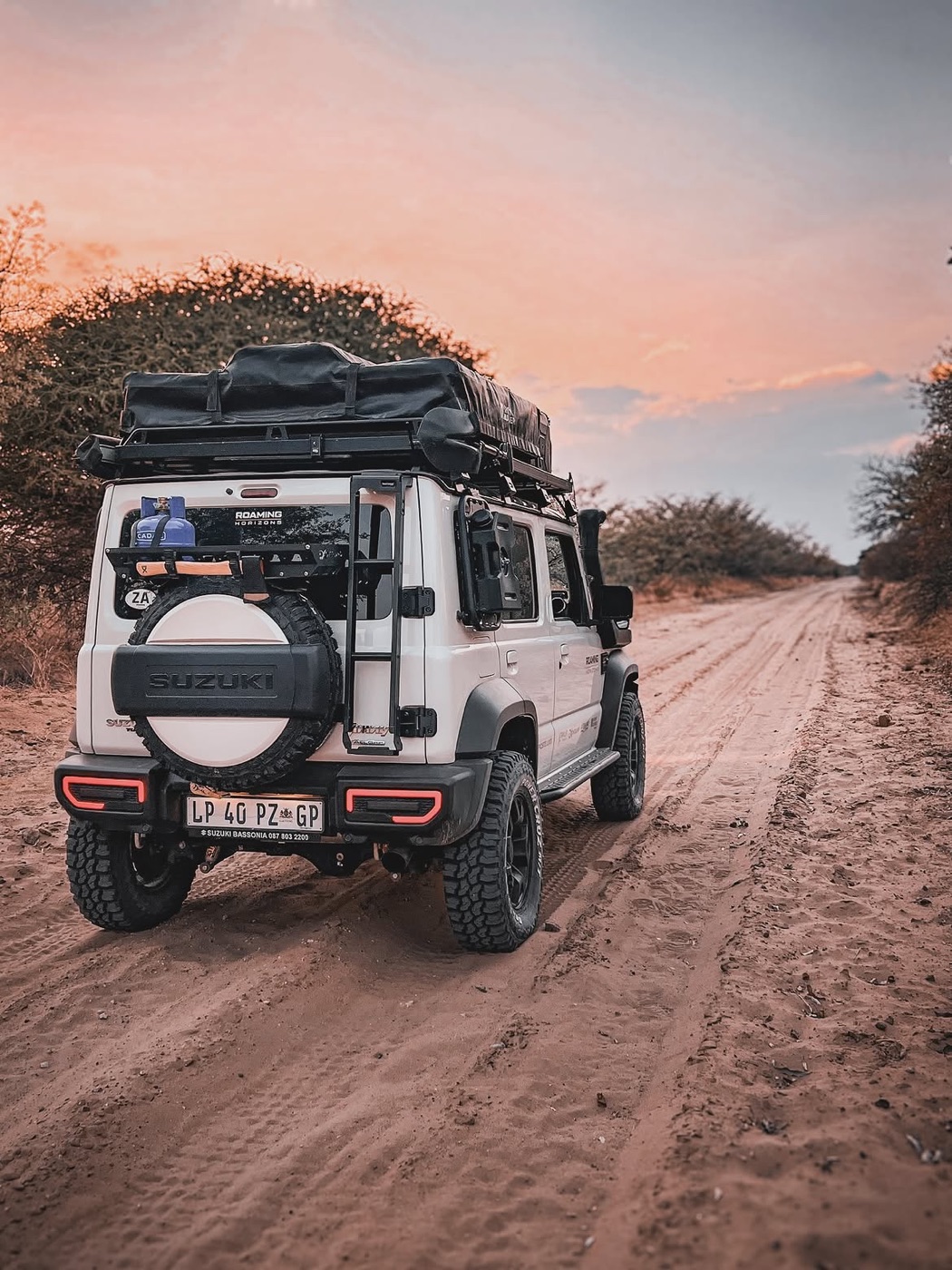
The Jimny is narrow and tall. It is 1,645 mm wide and 1,720 mm high, and weight on the roof raises the point it rocks around. We found no South African test of a tent Jimny for fuel, noise or braking, so we give no figures. But owners agree on the feel.
Wind is the big one. Karoo and Highveld crosswinds push even a bare Jimny around. With a tent up top, owners slow down a lot in strong wind. One older-Jimny owner who has toured with a tent since 2011 says you soon get used to it. He cruises at about 110 km/h and drops much lower in a gale.
Keep the tent low and back. A South African forum reply gives a tip worth keeping. Do not let the tent stick out far over the windscreen. At 120 km/h, air can catch the front of it.
Corrugations test the mounts. Long corrugated gravel, like the roads into the Kgalagadi or through Namibia, shakes a roof load far harder than tar. Have a professional fit the rack or bars, and check the bolts on the trip.
The cracked roof story. One owner cracked all four roof mounting points on Namibian corrugations. That was a 2017 older Jimny, carrying about 120 kg. He fixed the roof, added mounts and better suspension, and now runs a RoofPod. It is a story about ignoring the number, not a fault in the current Jimny.
Springs and shocks help you cope. Most tent builds add them. Some owners also fit air helper springs inside the rear coils, which they call airbags. None of it raises Suzuki’s 30 kg. Our lift kits and suspension guide has the kits and prices.
The lightest rooftop tents in South Africa
If you are set on a tent, weight is the spec that matters. These are the lightest we found. Prices were seen on 23 September 2026, VAT included.
| Tent | Type | Sleeps | Weight (as the maker states it) | Price | Where |
|---|---|---|---|---|---|
| RoofPod SoloPod | Clamshell pod | 1 | 30 kg, no ladder | R25,450 | RoofPod, Cape Town |
| RoofPod CoziPod | Clamshell pod | 2 | 40 kg, no ladder | R35,450 | RoofPod |
| RoofPod ComfyPod | Clamshell pod | 2 | 42 kg | R38,450 | RoofPod |
| Front Runner Roof Top Tent | Soft shell | 2 | 43 kg | R15,399 | JimnyworX |
| Alu-Cab LT-50 | Aluminium shell | 2 | 46 kg (51 kg with mattress) | R40,000 | JimnyworX |
| Front Runner Feather-Lite II | Soft shell | 2 | 49 kg, with ladder and cover | R16,500 | Dometic SA, JimnyworX |
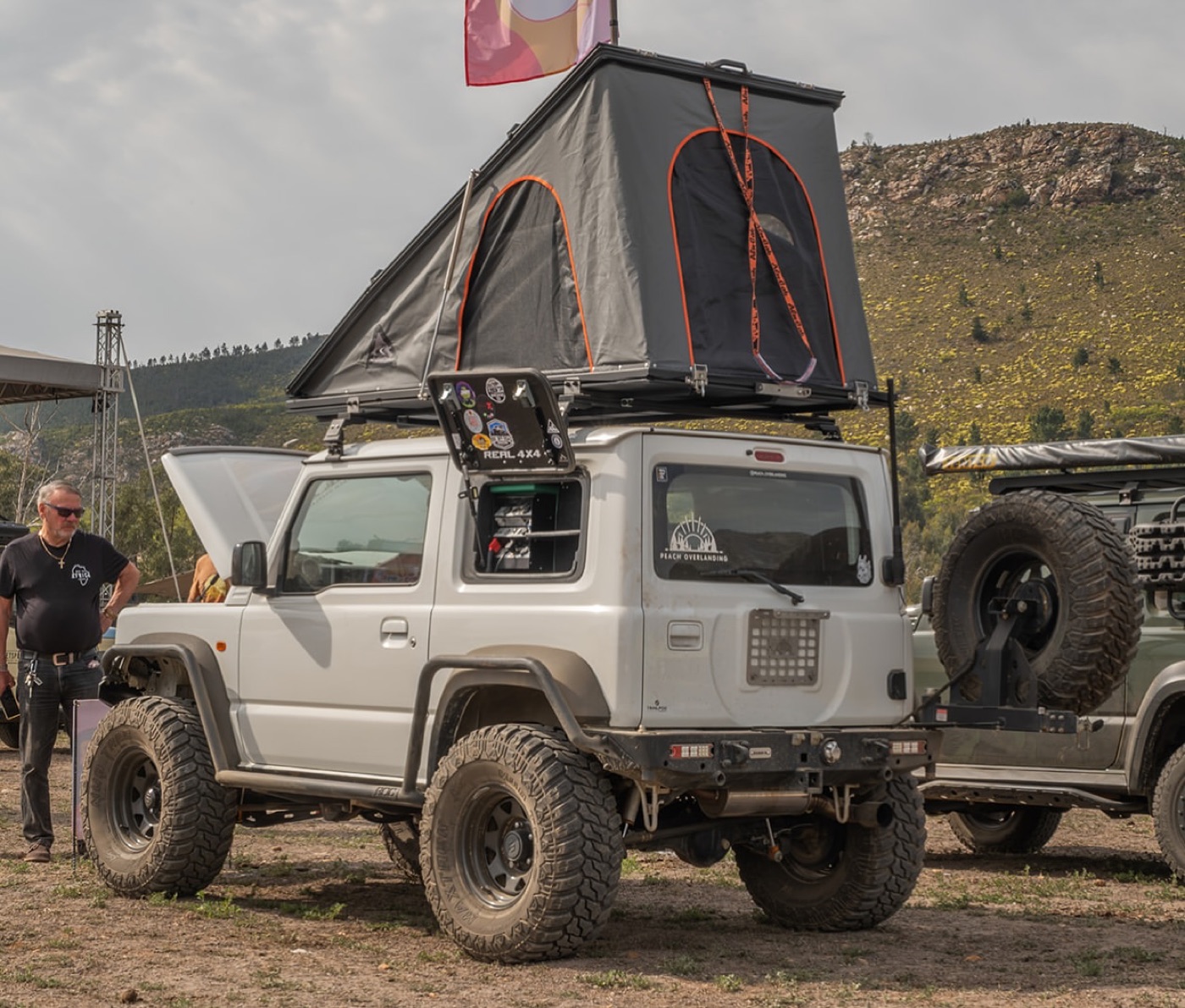
The RoofPod is the name South African owners raise first for a Jimny. It is a clamshell: two shells that hinge open into a tent. It packs to just 270 mm high, and it is made in Cape Town. RoofPod calls its pods the lightest clamshell tents in South Africa, and we found no lighter tent of any kind. The SoloPod is the only tent we found that weighs no more than Suzuki’s figure on its own. It sleeps one person, though.
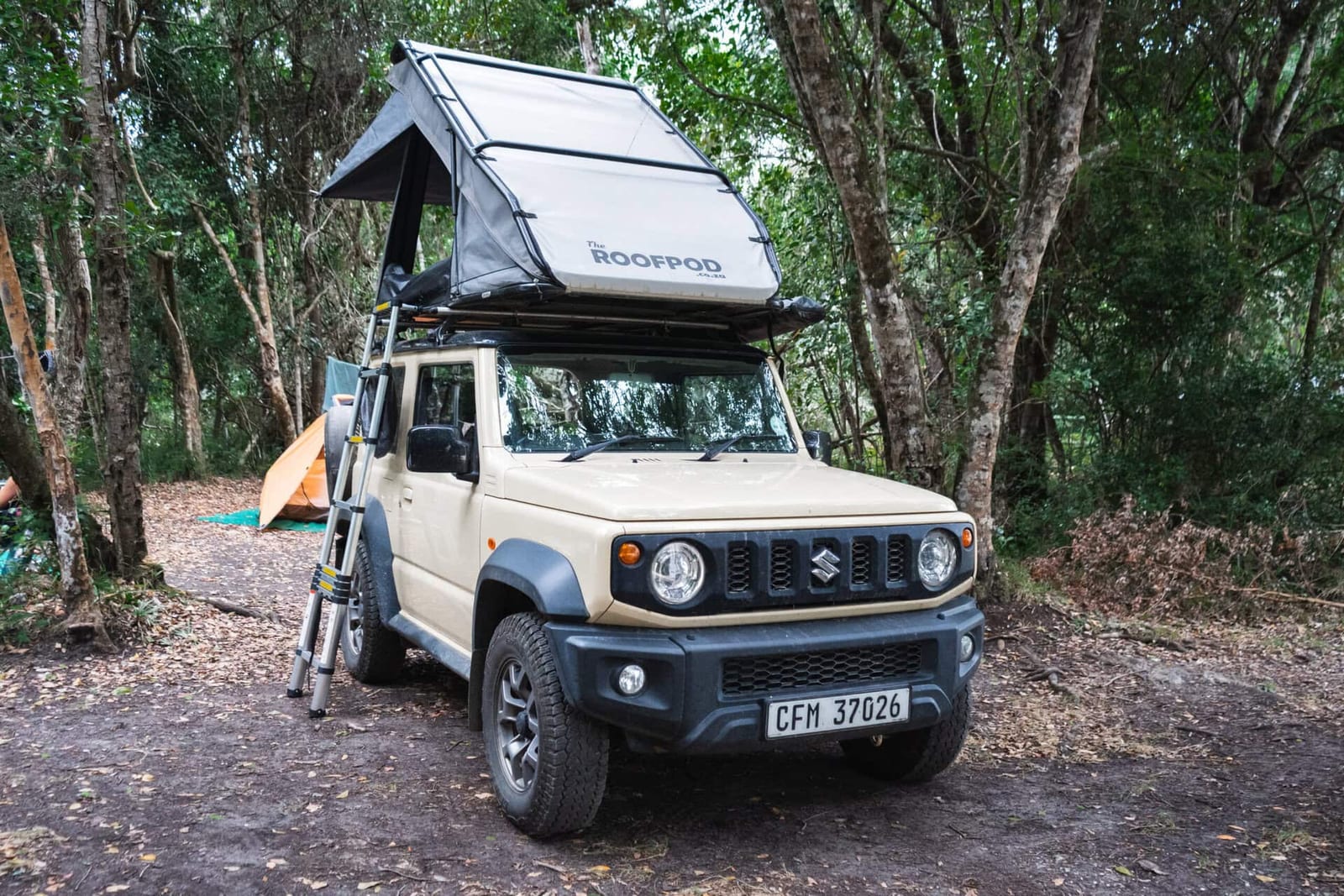
The Front Runner Roof Top Tent is the cheapest light tent from a big brand. It weighs 43 kg and packs to 330 mm high. It mounts on the rack many Jimny owners already have. JimnyworX in Cape Town still listed it at R15,399 in September 2026. Front Runner, now sold under Dometic in South Africa, also sells the newer Feather-Lite II at R16,500. It weighs 49 kg, but that figure includes the ladder and cover.
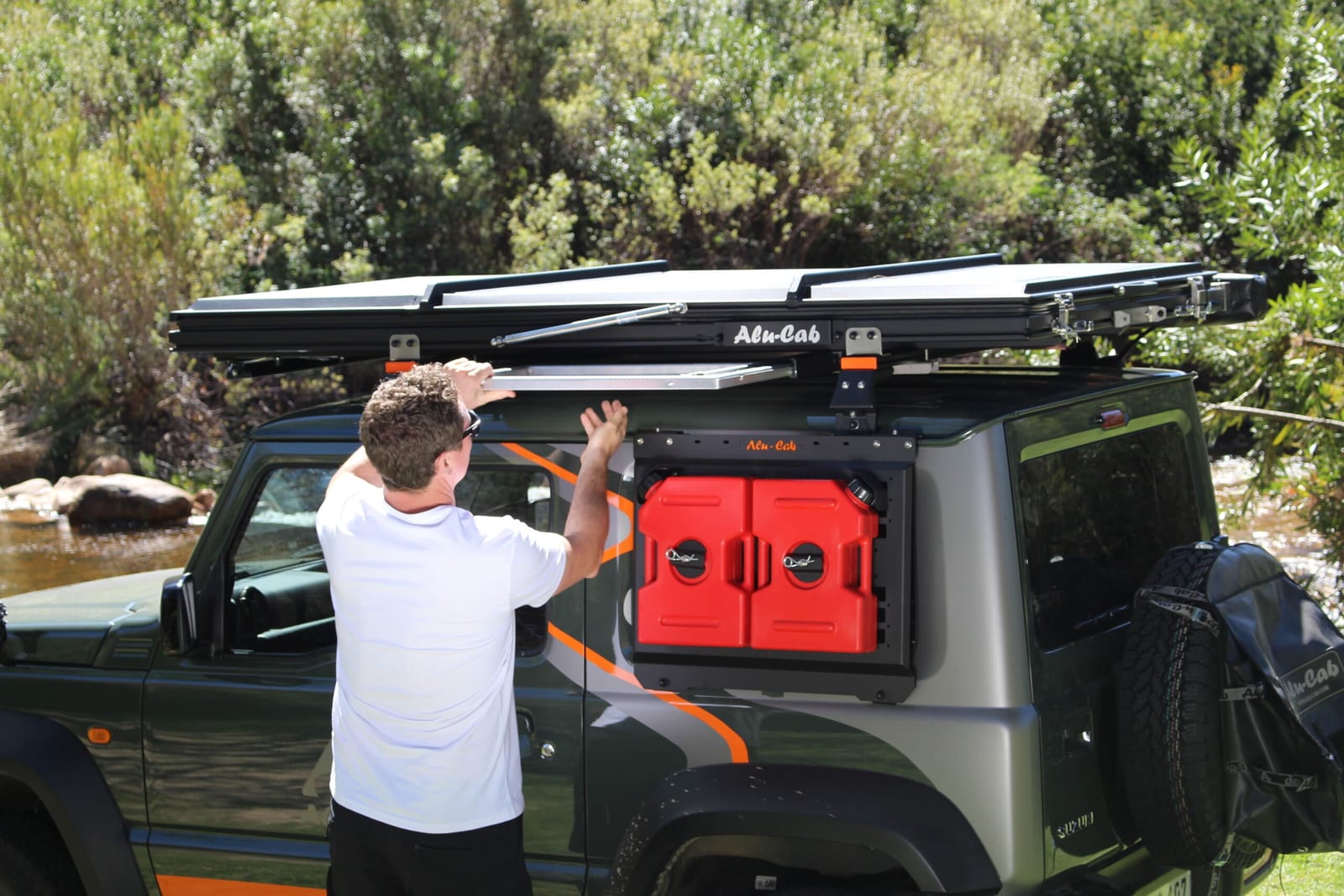
The Alu-Cab LT-50 is a hard shell of thin aluminium, from Cape Town’s Alu-Cab. Closed, it is only 172 mm tall, the slimmest tent here. A low tent catches less wind on a tall, narrow car. Alu-Cab lists both the Jimny 3-door and 5-door as a fit. It is not light, though: 46 kg for the tent, and about 51 kg with its mattress.
The heavier tents you will be offered
Every other tent we priced weighs 56 kg or more, where the maker gives a weight. They are good tents, many made here, built for bakkies and Land Cruisers. Where a tent is made does not change what it weighs.
| Tent | Type | Weight (as the maker states it) | Price | Where |
|---|---|---|---|---|
| Tentco 1.4 m Deluxe | Canvas soft shell | 56 kg | R15,200 (out of stock) | Tentco |
| Howling Moon Stargazer Delux 1.4 m | Canvas soft shell | 56 kg | R28,461 | Howling Moon, Cape Town |
| iKamper Skycamp 3.0 Mini | Hard shell | 58 kg | R59,000 | Wild Access |
| Quick Pitch AERO | Aluminium shell | 60 kg | R33,695 | Wild Access |
| Bush Cruiser 120 | Aluminium hard shell | 61 kg, with ladder | R35,995 (backorder) | JimnyworX |
| Eezi-Awn Sabre Lite | Hard shell | 70 kg | R41,000 | Eezi-Awn, Johannesburg |
| Alu-Cab Gen 3-R | Hard shell | about 76 kg, no mattress or ladder | Ask | Alu-Cab |
| Eezi-Awn Series 3 40th Edition | Canvas soft shell | Not published | from R28,150 | Eezi-Awn |
| Cloud Camper Ultra-Slim | Aluminium wedge | Not published | R26,900 | Cloud Camper, Johannesburg |
Prices seen on 23 September 2026, VAT included.
Note the Quick Pitch AERO. It is sold as lightweight, but it weighs 14 kg more than the LT-50. Even JimnyworX, a Jimny specialist, sells 60 kg class hard shells. The light tents are a choice you have to make on purpose.
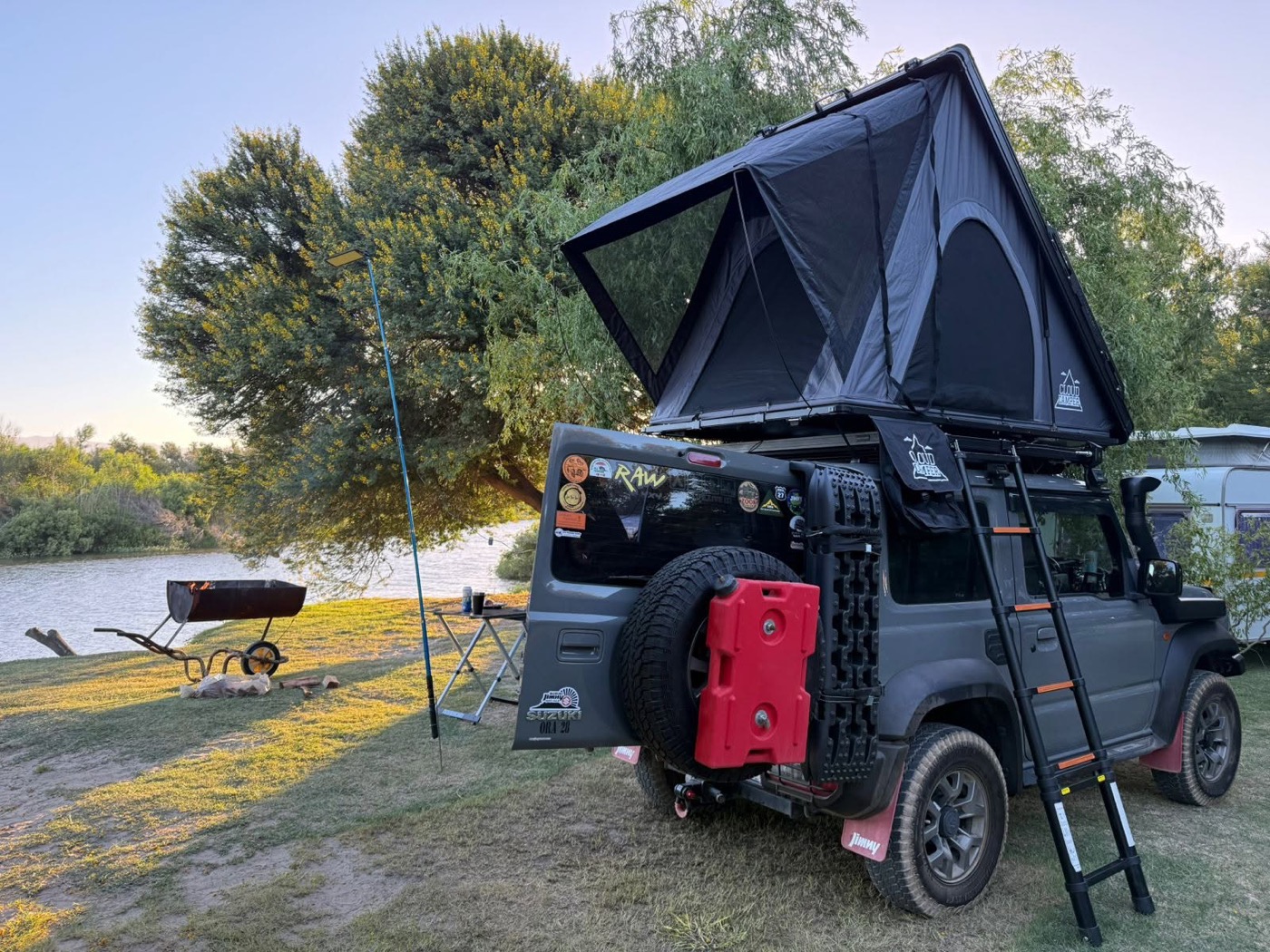
Cloud Camper tents turn up on Jimny roofs, and some owners run them on both bodies. Cloud Camper publishes no weight for any of its tents. On a Jimny, the weight is the spec, so get it in writing before you pay. To its credit, Cloud Camper is the one seller that prints a Jimny warning on its own page.
If you need a heavy hard shell, you need a bigger car. Our sister site’s rooftop tent guide for Land Cruisers covers that end of the market.
Where to buy a Jimny roof tent in South Africa
Jimny rooftop tents for sale in South Africa come from a short list of shops:
- The RoofPod sells its pods direct from Retreat, Cape Town, and offers finance.
- JimnyworX SA in Cape Town stocks the Front Runner tents, the Alu-Cab LT-50 and heavier hard shells like the Bush Cruiser.
- Dometic South Africa sells the Front Runner Feather-Lite II on its online store. JimSA lists it too, but it was out of stock.
- Wild Access sells the Quick Pitch and iKamper tents.
- Tentco, Howling Moon, Eezi-Awn and Cloud Camper sell direct.
Used tents come up on the forums and Gumtree. Ask for the weight, and check the mounts fit your bars.
Our rooftop tents and camping page does not list tents yet. It does compare awnings, tables and camp mounts across the Jimny stores.
Live prices · 4 October 2026
Awnings, tables and camp slides in stock now
7 in stock at 2 stores today, from R3 000 to R11 050. Typical price about R4 899.
Bars or a full rack?
Use the lightest mount your tent maker approves. The RoofPod and the LT-50 can sit on a pair of load bars, which weigh about 5 to 6.3 kg. A full platform rack weighs 22 to 38 kg. That difference is most of Suzuki’s 30 kg.
Both makers ask for bars at least 1.25 m long. Ask the tent maker whether your bars suit the tent before you buy. Front Runner tents mount on a Front Runner rack with a tent mount kit, about R1,200 at JimSA.
Our roof racks guide compares every rack and bar, with weights and prices.
Two small checks. On the 3-door, the aerial sits at the back of the roof, so make sure the tent base clears it. And a Front Runner tent mounted higher than 2 m needs its extension ladder. On a Jimny with a standard rack, the tent floor should sit at about 1.9 m.
A rooftop tent for the 3-door or the 5-door
A rooftop tent fits both. Alu-Cab lists the LT-50 for the 3-door and the 5-door, and the other light tents are sold for both.
The differences that matter:
- The roof figure. Suzuki SA gives 30 kg for the 5-door. It gives no figure for the 3-door, so ask your dealer.
- The rack. A full rack for the 5-door weighs more, because the roof is longer. The Front Runner Slimline II is 27 kg for the 3-door and 38 kg for the 5-door.
- What the car may carry. The 3-door can carry about 320 to 355 kg, and the 5-door about 330 to 360 kg. That covers people, gear and everything on the roof.
- Space inside. The 5-door has a bigger boot for the rest of the camp. Our 3-door vs 5-door guide compares the two.
Hire one before you buy
A rooftop tent is a big spend, so try the life first. Britz 4x4 Rentals hires out a camp-ready Jimny from its Johannesburg and Cape Town branches. It comes with a roof tent, a 270 degree awning, a fridge and two 20 L jerry cans. The price was from R1,610 a day in September 2026, and terms apply.
One owner suggests renting a RoofPod for a trip or two first. Take it on a long weekend with some gravel and some wind. You will know by Sunday.
A hire car is not proof the roof load is fine. It is a cheap way to find out if you like tent life.
The smarter options: keep the roof light
These options keep the roof light and sleep you just as well.
1. A ground tent. It rides inside the car and adds nothing to the roof. A Howling Moon Safari Dome was about R9,200 in September 2026. A Tentco Junior Wanderer bow tent was R5,200 and weighs 20 kg all in. Owners pair a quick-pitch tent with stretchers and self-inflating mattresses.
2. Suzuki’s own tent. Suzuki SA sells an Attachable tent for the Jimny, made with the Japanese tent maker Ogawa. It is a ground tent that pitches beside the car. It weighs 2.5 kg and packs to 58 cm long. Ask your Suzuki dealer for a price.
3. An awning and stretchers. An awning gives you shade and a dry kitchen. It goes on the roof, so its weight counts toward the 30 kg. Check its weight, plus its brackets, before you fit it.
4. A tent on a trailer. The tent rides on a small trailer, so the roof carries none of it. The 3-door may tow 1,300 kg with a braked trailer, and 350 kg with an unbraked one. Suzuki SA publishes no 5-door towing figure. A small camping trailer with a tent, fridge and gear can pass 350 kg fast, so check whether yours needs brakes. Our towing guide has the numbers.
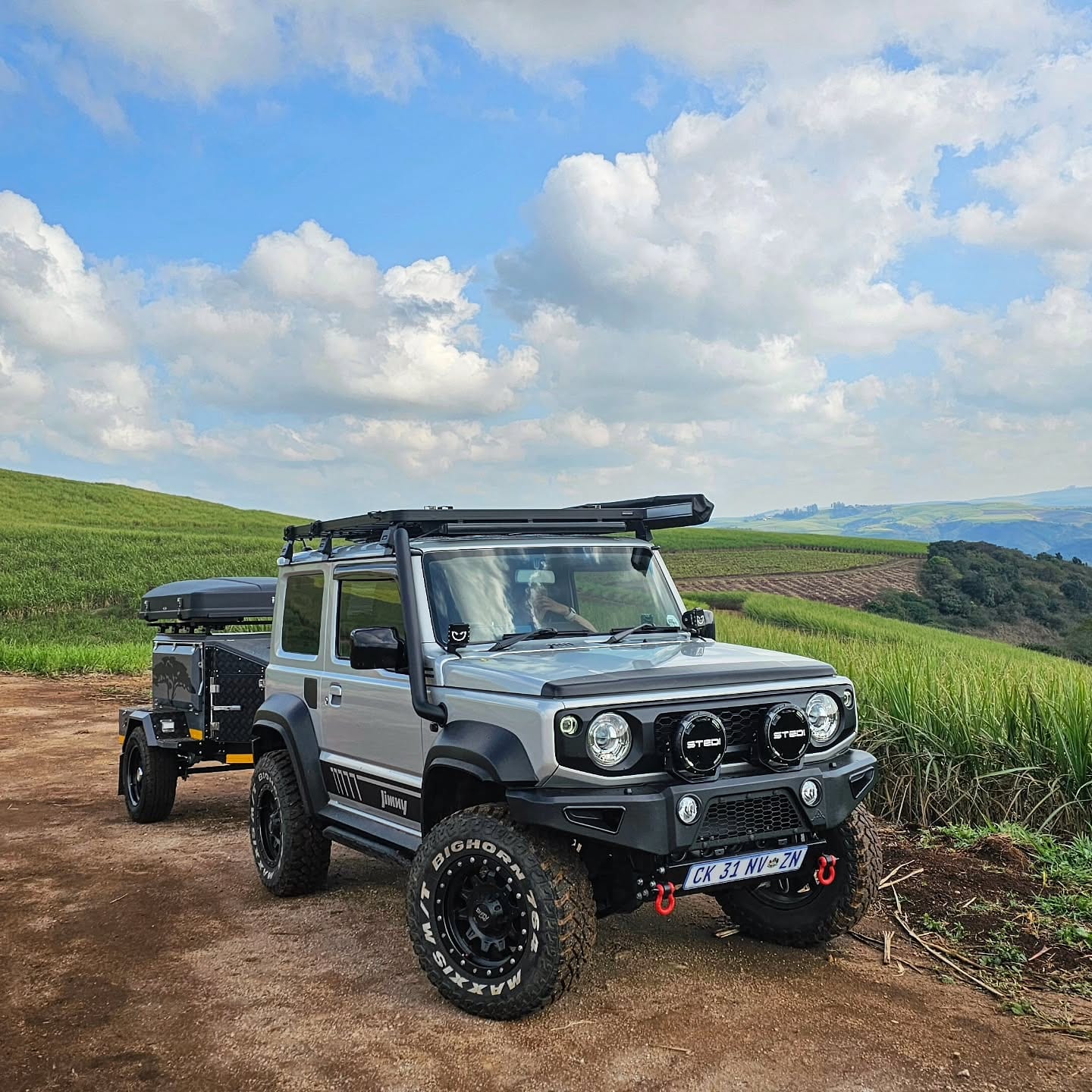
The trailer has one killer argument in our national parks. In the Kruger or the Kgalagadi, you set up camp at two in the afternoon. With the tent on a trailer, or on the ground, you unhitch and go on the evening game drive. You come back to a camp that is already up. With the tent on the roof, you pack up camp every time you want to drive anywhere.
Trailers have their own cost. Towing with a Jimny is slow, and some owners find it nerve-wracking in wind.
If you still want a rooftop tent
Some owners weigh all this and fit one anyway. Here is how the careful ones do it:
- Buy the lightest tent that sleeps the people you have.
- Mount it on light bars, not a full platform, if the tent maker approves.
- Keep it low, and do not let it hang out over the windscreen.
- Put nothing else on the roof. Full jerry cans go inside or on a trailer.
- Fit good springs and shocks for the weight.
- Drive slower, leave bigger gaps, and back right off in wind.
- Tell your insurer about the tent and the rack, and get their answer in writing.
Accept that you are over Suzuki’s figure. An insurer could question a claim after an accident where the roof load played a part.
Who should buy what
| You | Best choice | About |
|---|---|---|
| Solo traveller who wants off the ground | RoofPod SoloPod on light bars | R25,450, plus bars |
| Couple, roof as light as possible | RoofPod CoziPod on light bars | R35,450, plus bars |
| Couple on a budget with a Front Runner rack | Front Runner Roof Top Tent | R15,399, plus a mount kit |
| Want a hard shell and the least wind | Alu-Cab LT-50 | R40,000 |
| Want to stay inside Suzuki’s figure | A ground tent or Suzuki’s Attachable tent | from about R5,200 for a ground tent |
| Kruger and Kgalagadi trips | A tent on a braked trailer, or a ground tent | Ask a trailer builder |
| Not sure you will like it | Hire a camp-ready Jimny for a trip | from R1,610 a day |
The bottom line
A rooftop tent on a Jimny is a trade-off you make with your eyes open. Suzuki’s figure is 30 kg, rack included, and every tent setup we found is over it. The lightest tent in South Africa on light bars comes closest. If you fit one, keep it light and low, and drive like you know what is up top. If you would rather not fight the roof figure, a ground tent, Suzuki’s own tent or a trailer sleeps you just as well.
Planning the rest of the build? Our Jimny accessories guide and storage and drawers guide cover what goes inside. Still shopping for the car itself? See our price guide and the Jimnys for sale right now.
A big thank you to the people whose photos made this guide: Roaming Horizons, Peach Overlanding, @dirt_road_duo, The RoofPod and Alu-Cab in Cape Town, and Cloud Camper in Johannesburg. Go and see their work, and support the local people who keep South Africa’s Jimnys camping.